
:format()//media/user-generated-content-in-higher-education--RQ.png)
Your prospective students may not fully trust you…not yet.
That’s the reality of where young people are when they first encounter your institution. They’ve grown up watching brands perform their authenticity rather than practice it. They’re e good at spotting the difference between a polished campaign and a genuine story.
So when prospective students are making one of the biggest decisions of their lives, they look to those who’ve already gone through what they are going through now, and whom they do relate to: their peers, the students already on campus, voices that aren’t paid to say nice things.
That’s the environment user-generated content (UGC) operates in.
And for higher ed marketers, it’s one of the most credible although underused assets available.
The trust gap is real
A recent E-Expectations Trend Report found that 84% of students say social media is a helpful tool for researching colleges. What they’re looking for, in practice, is peer validation: evidence that real students chose this institution, enjoy being there, and would do it again.
Meanwhile, the channels where UGC lives naturally, such as TikTok, Instagram Reels, Reddit, and. YouTube are central to how prospective students do their research.
A campus walkthrough on TikTok might be your institution’s first real impression; a Reddit thread about housing might tip a student toward or away from applying.
We know UGC influences enrollment decisions, but the real question is, are you able to do anything intentional with it?
What good UGC looks like in practice
Some institutions have already figured this out.
- University of California, Los Angeles (UCLA), for example, has built a TikTok account of more than 200,000 followers by centering student-generated content, giving applicants an unscripted view of campus culture through the students who live it. Here's an example of a campus tour video featuring student guides that racked up 34,000 likes and nearly 400 comments, driven entirely by students showing off their campus in their own way, using a trending audio clip.
- Michigan State University gave grad students a camera and let them explain what a day in their life looks like on TikTok (29.9K likes).The result was content that actually offered a fun way to get a taste for MSU and what studying life looks like from the inside, an approach that helped build an account with more than 843,000 likes.
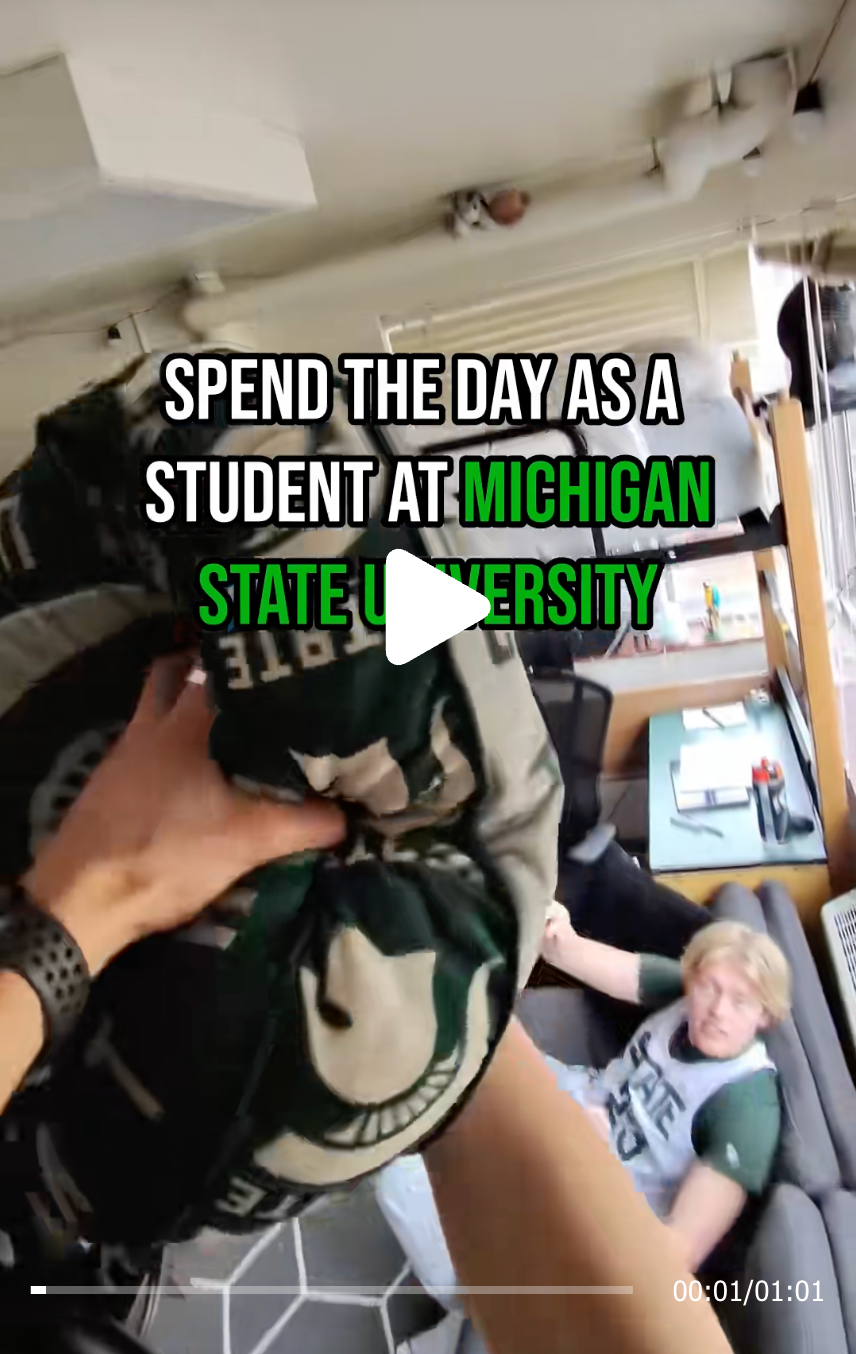
- Lancaster University in the UK handed creative control entirely to student ambassadors when promoting its online open days, letting them make TikTok in-feed ads using trending formats like dancing, reversed video, and popular filters, rather than scripted content.

This TikTok for Business case study tells a full story: more than 10 million impressions, 9 million engagements, and 90,000 click-throughs...all on a tight budget, without an agency.
There’s a broader shift in how effective higher-ed marketers think about recruitment content toward less-produced, more peer-driven material.
UGC works differently for domestic and international audiences
For domestic prospective students, the central question, above and beyond if it's a good university, is can they see themselves there.
They want to know what day-to-day life feels like: the social scene, the campus vibe, the kind of people they’d be studying alongside.
Peer content answers those questions far more convincingly than institutional messaging because it comes from someone who was recently asking the same things.
For international students, UGC functions as a risk reducer. Moving countries to study is a high-stakes decision. A video from an international student already on campus, whether speaking honestly about the transition, the social scene, or the practical realities, among other topics, carries enormous weight not just for the student but for the families involved.
Student-led content showing campus diversity, religious observance, and everyday social life answers questions that prospective international students are often reluctant to ask directly — about safety, inclusion, and belonging.
Your UGC strategy shouldn’t be one-size-fits-all. What reassures a domestic undergraduate comparing two local universities is different from what reassures an international family weighing the prospect of sending their child abroad.
How to encourage content without manufacturing it
The first temptation is to over-engineerbriefs, talking points or approval chains—until it no longer reads as student content at all. Resist that.
The idea is to create conditions where students want to share, then make it easy for them to do so.
- Give students something worth sharing: From orientation moments and open-day experiences to campus traditions, students document what feels significant. Your job is partly to make sure those moments exist.
- Work with students who are already creating: Look for students active on TikTok or Instagram before you try to recruit new ones. Lancaster found student ambassadors willing to make content that genuinely reflected how they used the platform; Michigan State identified grad students ready to explain their own research on camera.
- Create low-friction sharing pathways: Create a hashtag that students actually use, such as for an ambassador program with genuine creative latitude instead of a script. The lower the barrier to participation, the more organic the contribution.
- Ask at the right moment: Students who’ve just had a positive experience, such as at an open day or after receiving an offer, are more likely to share. A well-timed, specific ask converts better than a standing generic request.
Governance: the part most institutions underinvest in
Student content doesn’t map neatly onto the centralized workflows that official channels require. Content comes in on a phone, in a format you didn’t ask for, outside business hours.
Getting that to work alongside your CMS/DXP and brand governance takes deliberate design.
- Permission is non-negotiable: Before any student content appears in an official channel such as your website, social accounts, and paid media, you need explicit, documented consent specifying how it will be used, where, and for how long. A retweet is not consent. This matters especially for international students, whose home countries may operate under different privacy frameworks.
- Assign clear ownership: Someone on the team needs to own the UGC pipeline, including managing contributor relationships, overseeing consent, and curating incoming content. Without a clear owner, content either stalls or bypasses governance entirely.
- Integrate UGC into your CMS/DXP workflow: Student content used in official channels needs the same version control, approval steps, and audit trail as anything else you publish. Without that integration, you end up with an informal parallel process that creates brand and legal risk.
- Maintain editorial oversight without rewriting everything: Review for factual accuracy and safeguarding concerns, then largely leave the voice alone. Wholesale rewrites produce content that no longer reads as UGC, defeating the purpose.
The authenticity line
There’s a version of UGC strategy that tips into something less honest: sponsored content without disclosure, campaigns so heavily structured that the “student voice” is indistinguishable from marketing copy, or selective amplification that papers over genuine student concerns.
Prospective students notice. And when they do, the damage to trust is worse than if you’d never tried UGC at all.
The strongest UGC programs are ones where the institution is confident enough in the actual student experience to let students describe it, largely in their own words.
That confidence must come from the experience itself.
If gaps exist between what your campaigns promise and what students find on arrival, UGC will eventually surface them.
The institutions that recruit most effectively won’t necessarily be the ones with the biggest budgets.
They’ll be the ones that prospective students trust.
Your students are already telling your story. The question is whether you’re making space for their voices in the channels where the decisions actually get made.
How does your institution approach student-generated content in recruitment? We’d love to hear what’s working—find us on LinkedIn.