
:format()//media/St.-Ambrose-University---AI-visibility-RQ.png)
Higher education teams are getting serious about AI search.
Content is being rewritten, schema is being added, and SEO strategies are expanding into AEO and GEO.
And across your university or college, there's a growing awareness that students may now ask an AI tool where to study before they ever visit your website.
But there's a measurement problem.
Most analytics tools were built to show what people do on your site, not to show, in detail, what AI bots are crawling (nor what they're missing), or whether your structured content is actually being picked up.
That leaves a gap.
Many institutions can say they are optimising for AI visibility, but far fewer can say they have evidence that it is working.
St. Ambrose University is one team asking the next question: what does it look like when a higher education digital team takes AI visibility seriously?
A small team with a big digital remit
The St. Ambrose University web and digital team, Alison Amyx (Senior Director of Strategic Marketing Operations) and Ailiyah Alim (Web and Digital Content Specialist) is working across strategy, user journeys, SEO, and generative AI implementation.
Like many higher education digital teams, they're balancing a wide set of priorities: they're thinking about how prospective students discover the university, looking at how content supports decision-making, and also exploring how emerging AI search behaviours might change the way students find answers.
Their starting point was practical.
They had done the work, invested in schema, and were watching AI visibility metrics. And they were also thinking about the role of generative engines in student search.
But they wanted to know more.
Was the work landing? Were AI crawlers actually engaging with their content? Were important pages being discovered? Were technical issues getting in the way?
That curiosity moved the conversation from AI search theory into something much more useful: measurement.
Schema at scale is the first serious move
St. Ambrose implemented schema across 100% of relevant pages.
Schema helps search engines and other systems understand what a page is about.
For higher education, that can include information about programs, courses, events, FAQs, locations, and other content students often need before they make an enquiry or apply.
Traditionally, teams have thought about schema through the lens of SEO, in that it helps search engines interpret content more clearly and can support richer search results.
But in the age of AI search, schema has a wider role.
Generative engines need clear, structured, trustworthy information to produce useful answers.
"The foundation of our AI visibility work is a strong content strategy," explains Alison Amyx, Senior Director of Strategic Marketing Operations, "When we launched our new website with Terminalfour in 2024, we streamlined our content. This smaller footprint forced us to focus on answering critical questions, meeting user needs, and clarifying calls to action. This also gave us more control over the information LLM crawlers use to form their responses, and it's easier to ensure accuracy on a smaller site. We have more confidence that chatbots are presenting reliable information about our university. "
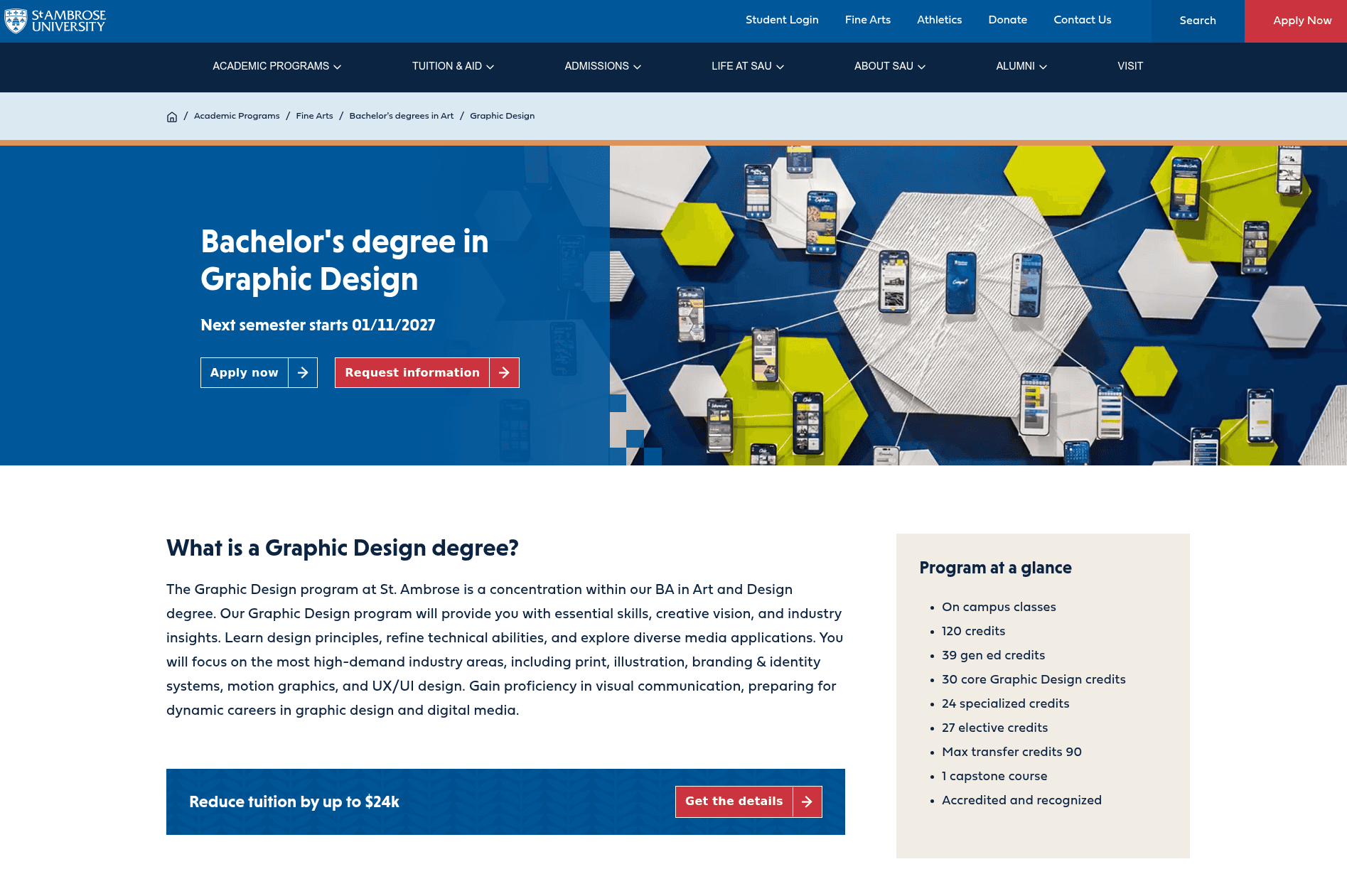
When a prospective student asks an AI tool what or where they should study, is your university's content ready to be found and understood?
St. Ambrose has focused on creating clear, structured program content that works for prospective students and is easier for search and AI systems to interpret.
If your higher ed content is outdated, buried in inconsistent page layouts, vague copy, or unstructured formats, it becomes harder for AI tools to understand and surface it confidently.
That's where GEO, or generative engine optimisation, comes in.
GEO does not replace SEO. It builds on it. The goal is to make your content easier for both search engines and AI-powered answer engines to understand, cite, and recommend your content to prospective students.
At St. Ambrose, schema became the foundation: it gave the team a stronger technical base for visibility, and early signals through Semrush showed growth in AI visibility metrics.
That's really encouraging. But it still didn't answer every question.
Standard analytics only tell part of the story
Tools like Semrush and Google Analytics are useful starting points.
They can show referral traffic from AI platforms and help teams monitor visibility trends.
They can also reveal whether AI-driven sources are beginning to appear in the wider acquisition picture.
But unfortunately, they don't show everything.
In particular, they don't give a complete view of direct bot interaction.
What can help is log file analysis, and this is where it gets really interesting.
Server log files can show which bots are visiting your site, which pages they are crawling, how often they return, and what errors they encounter.
"Because LLM platforms are relatively new," Alison explains, "we haven't found clear and consistent guidance on measuring success. Early on, we created a custom channel group in Google Analytics to segment visitors from LLMs into their own category called 'AI Traffic.'
"While we can see that this traffic is increasing, we also know that "no click" behavior means many users will encounter our brand without ever visiting our website. Analyzing server files shows us how LLM crawlers are accessing our content, which provides clues about the ways our content is presented to users."
For teams trying to understand AI visibility, that's a completely different level of insight
It helps answer questions higher ed marketers will be asking about their content, such as:
- Are AI crawlers reaching our most important pages?
- Are they crawling pages with schema?
- Are they repeatedly hitting 404s?
- Are they missing key areas of the site?
- Did something technical cause a sudden drop or flatline in activity?
A lot of higher education teams aren't asking these yet, but they should be.
Because once AI search becomes part of the student journey, visibility is no longer just about rankings but about whether your content is accessible, understandable, and technically available to the systems students are using to make decisions.
"And thanks to our phenomenal content, creative, and enrollment communications teams, our brand value is clear and consistent," says Alison, "Site visitors know exactly how to take the next step in their enrollment journey. Two years after launching our new website, our sitewide conversion rate for applications and inquiries has increased by 56%. "
What bot traffic can reveal
St. Ambrose wanted to go deeper into the data.
They were seeing patterns that deserved investigation, including non-human traffic spikes in Google Analytics and a mysterious flatline period.
Tools like Siteimprove have helped St. Ambrose identify and address page-level issues that might block visitors from accessing their content.
These kinds of signals can be easy to ignore, especially when a small team is already stretched.
But ignoring them can also mean missing the bigger story.
Bot traffic isn't always a useful engagement signal. In many cases, it's just noise… But that doesn't mean it's not important.
If AI bots are crawling important academic program pages, that may show your content is being discovered; if they are repeatedly hitting errors, that may point to technical clean-up work. If bot activity suddenly drops, that may be a sign that something changed in site access, crawl behaviour, or the wider search ecosystem.
Log file analysis turns those vague possibilities into clearer questions.
It can show the split between human and bot traffic and reveal which pages bots are accessing most often.
It can also identify 404 patterns and other technical issues, and help your team understand whether your schema-rich pages are actually being reached. This is forensic SEO.
It is technical, yes, but it's also really strategic, because you can't really optimise what you can't see.
From visibility signals to enrollment outcomes
In September 2025, St. Ambrose invested in Semrush's AI Visibility tool to track brand performance and perception across LLMs.
In the first six months, St. Ambrose's monthly audience within LLMs grew 320%, brand mentions rose 107%, and domain citations increased 81%.
It's also important to frame results: Enrollment outcomes are influenced by many factors, from academic offerings and admissions activity to market conditions, communications, financial aid, campus visits, and brand strength.
So schema and AI visibility work can't be treated as the only cause, but they can be part of a stronger digital performance picture.
When prospective students are searching in more fragmented ways, your content needs to be discoverable across more environments.
So while traditional search still matters (so does your website!), AI-generated answers, answer engines, and emerging discovery tools are more and more part of the decision journey.
St. Ambrose's approach shows what it looks like to treat that shift seriously.
They didn't stop at "we added schema," but they asked whether it was being seen.
Instead of just "AI referral traffic appeared in analytics," they took the time to find out what bots were actually doing.
Anomalies weren't treated as distraction…they were clues; that's a different mindset, and one that will yield results.
What you can do next with AI visibility
The good news is that your university or college doesn't need to start with advanced log file analysis.
You can start with schema, looking at your highest-value pages first: program pages, admissions content, cost and aid information, visit pages, FAQs, and location-based content are all strong candidates.
If those pages are central to student decision-making, they should be clear, structured, and easy for search systems to understand.
Then use the tools you already have: Semrush and Google Analytics can help you spot early AI visibility and referral trends.
They won't answer every question, but they can help your team build a baseline and start asking better ones.
From there, begin the conversation about log access, an emerging need for higher education web teams.
As AI search becomes more important, higher ed institutions will need better ways to understand crawler behaviour, technical barriers, and content visibility.
The bigger goal is the feedback loop, so visibility can lead to measurement, and that can lead to insight, which leads to iteration.
And this cycle is what can make AI visibility sustainable.
AI search isn't a one-time project
AI search isn't a channel you optimise once and walk away from (sadly).
It's quickly becoming an ongoing activity that connects content strategy, technical SEO, structured data, analytics, and governance.
The institutions that treat it that way will be better placed to understand how students are discovering them, where content gaps exist, and how their digital presence appears in AI-generated answers.
St. Ambrose University's work offers a useful model.
So be curious. Get structured. Look at the data others are ignoring.
And be willing to ask uncomfortable questions when the numbers don't behave as expected (and they won't).
Because when a prospective student asks an AI tool what to study, where to apply, or which university is right for them, your content needs to be ready.
Is your team tracking AI bot behaviour yet, and what are you seeing? Share your thoughts with us on LinkedIn.