
:format()//media/interactive-video-for-higher-ed-marketing-RQ.png)
Higher education is getting really good at video.
We've seen it in campus tours, student stories, course explainers, day-in-the-life TikToks, Open Day highlights.
There's certainly no shortage of things for prospective students to watch.
But what if they could actually do something with that video, like choose the course they want to explore, tap through different study options, look around a campus in 360 degrees, find out about accommodation, or even jump straight to application information?
That's where some universities and colleges are really innovating, with interactive video games.
They're building interactive advertising campaigns and virtual campus experiences, interactive prospectuses, and even recruitment games.
So, what exactly is interactive video?
The simplest distinction is that normal video asks you to watch, while interactive video asks you to participate.
That interaction can be relatively simple: a clickable call-to-action, an information panel, a poll or a gallery that opens alongside the video.
Or it can go much further.
Viewers might choose between different paths, tap hotspots, swipe to reveal information, or move around a 360-degree environment.
They give prospective students some control over the experience.
Which makes sense, really, because prospective students rarely have just one question.
A student might be interested in Computer Science, but also want to see the campus and where they'd live, or look at scholarships and find out how to apply.
One two-minute brand video, as good as it is, can't necessarily anticipate that journey.
But an interactive experience can let the student shape it for themselves.
Interactive or immersive? There is a difference
Interactive and immersive are two terms that are often bundled together, but they're not quite the same thing.
An interactive experience requires the viewer to do something. An immersive experience tries to make them feel as though they're somewhere.
A 360-degree campus tour is a good example of immersion.
Instead of watching someone else walk around campus, prospective students can look around for themselves.
Add clickable locations, student videos, or course information and the experience becomes interactive too.
VR can take this further, but you don't necessarily need a headset or a huge production budget to make video more participatory.
And increasingly, some of that interaction can happen right inside an ad.
There's some interesting research behind it
Research highlighted by City St George's, University of London looked at 250 mobile advertising campaigns involving almost 270,000 consumers.
They identified three particularly effective forms of interaction:
- Browse: "Browse" lets people explore things such as hotspots and galleries.
- Sample: "Sample" gives them a virtual experience of something.
- Play: "Play" brings gaming or choice into the experience.
All three increased brand choice in the study, but play produced an average increase of 36.6%, while browsing only 31.5% and sampling only 29.6%.
Those figures aren't from higher education campaigns, so we shouldn't assume that adding a quiz to an admissions ad will suddenly increase applications by 36.6%.
But the behaviours themselves translate rather neatly:
- Browse your courses.
- Sample life on campus.
- Play with different routes through a student story.
You can probably already think of content on your website that fits each one.
The University of Tasmania puts interactive advertising into practice
One higher education examples comes from the University of Tasmania.
The University worked with Pivotus and VDX.tv on an interactive video campaign designed to engage prospective students and encourage them to explore courses and the application process.
Instead of expecting one video to do everything, the ad gave students different ways to continue exploring.
A Video tab introduced the University and Tasmania, a Courses tab opened an interactive gallery where students could browse individual courses, and an Apply section provided information about online study, financial support, and applying.
The interaction wasn't bolted on to make the ad look clever; it answered the questions a student might naturally have after watching it.
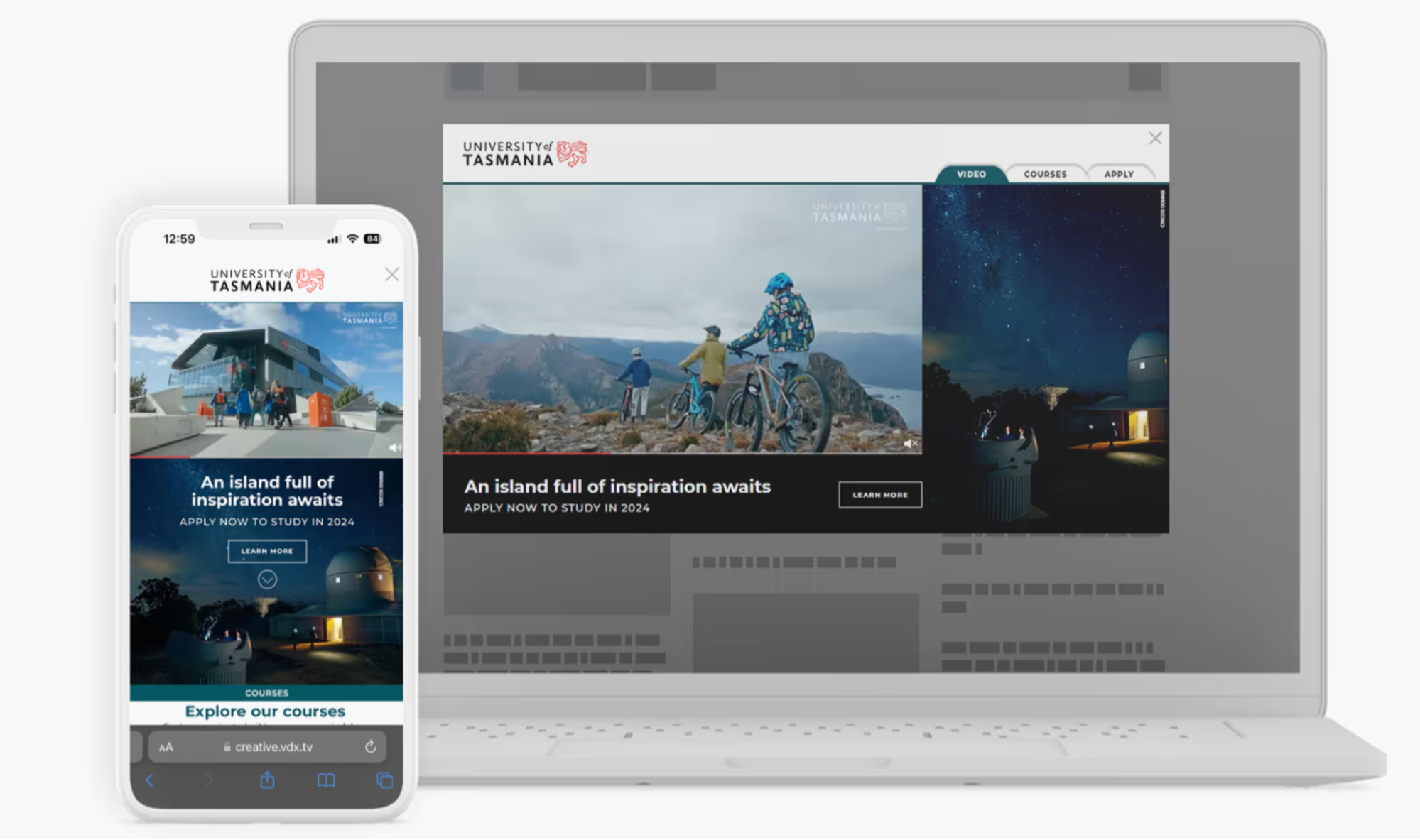
University of Tasmania created a video-powered campaign with Pivotus & VDX.tv to drive prospective student engagement. Source: https://www.vdx.tv/case-studies/university-of-tasmania
According to VDX.tv, the campaign recorded a video completion rate 26% above benchmark, a click-through rate 150% above benchmark, and average time spent 37% longer than benchmark.
For higher ed marketers, there's a useful idea here: don't just think about how to get someone to watch your video, think about what you want them to do while you've still got their attention.
Interactive video doesn't have to be a complicated choose-your-own-adventure film. It can also be making useful information around the video much easier to explore.
Gonville & Caius has replaced the printed prospectus
Interactive video doesn't have to live inside paid media either.
Gonville & Caius College, Cambridge has taken a more radical approach to one of the oldest pieces of university recruitment collateral: the prospectus.
It no longer produces a printed prospectus. Instead, prospective undergraduates are directed to an interactive video guide.
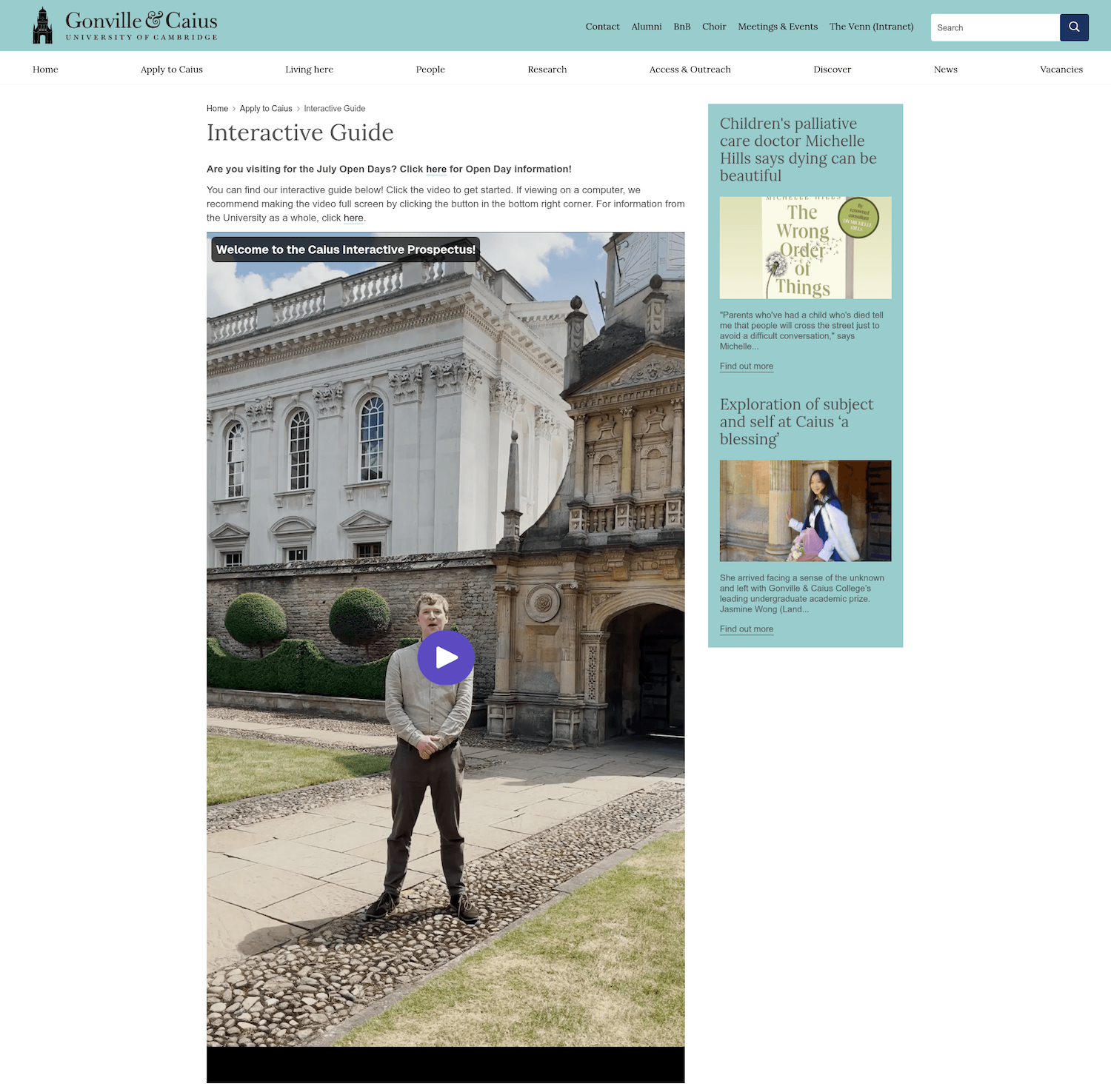
Gonville & Caius College has done away with the paper and digital prospectus
and gone interactive.
The experience brings together perspectives from students, and faculty and staff members, giving prospective applicants a way to explore the College digitally rather than working through a traditional linear publication.
There's something very appealing about this idea, it feels warmer and more personable.
A prospectus is supposed to help a prospective student explore. Why shouldn't they control the route?
The University of Vermont puts prospective students in the middle of campus
Then there's immersion.
The University of Vermont currently offers prospective students a collection of 360-degree VR experiences covering campus spaces and student experiences.
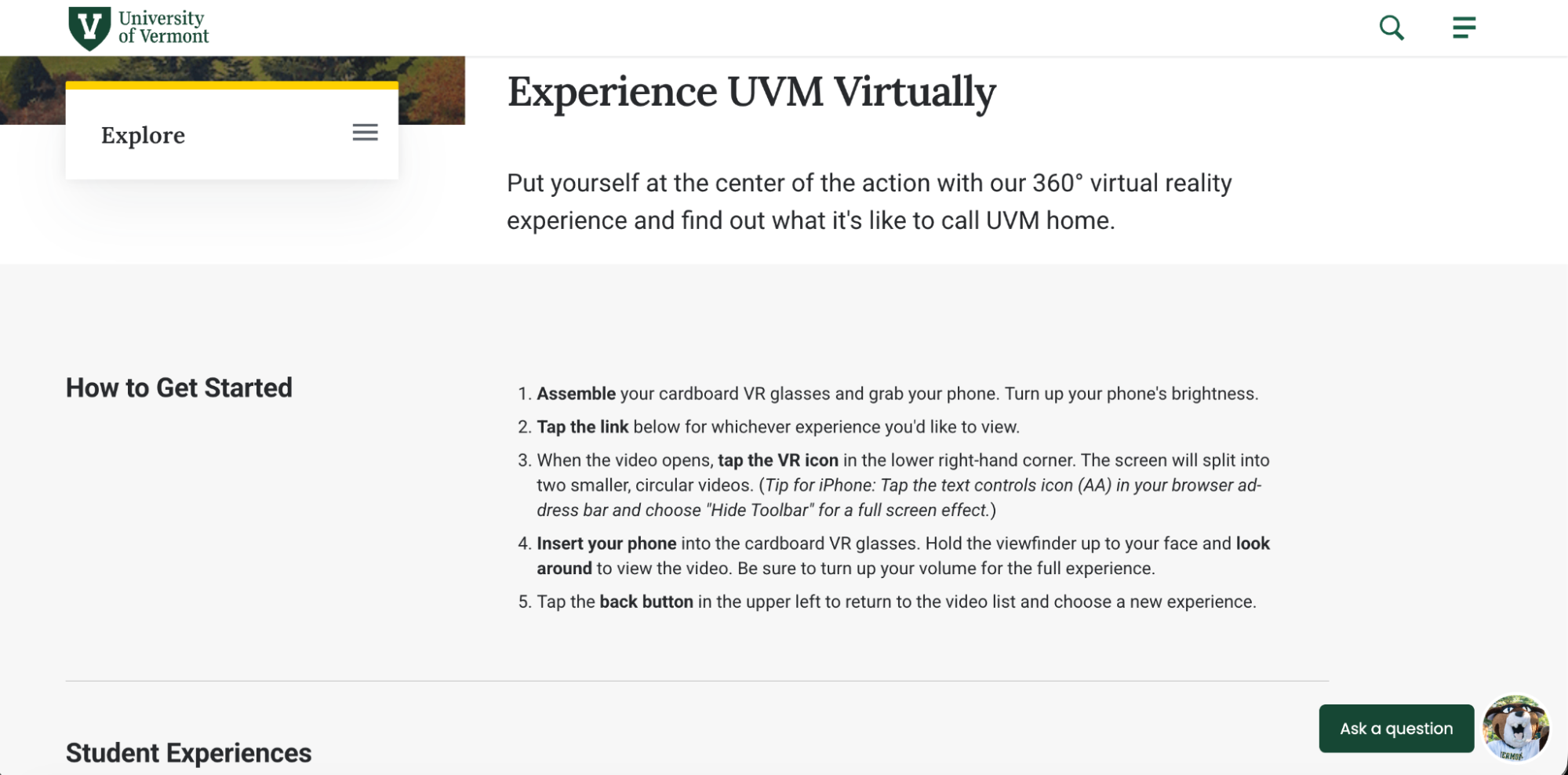
Students can put a phone into a cardboard VR viewer and look around experiences including campus events, classes, residence halls and outdoor activities. They can also view the videos without a headset.
There's a very practical recruitment problem behind all of this: how do you give someone a meaningful sense of place when they can't visit?
Rather than simply showing prospective students what Vermont looks like, the University gives them some control over where they look.
Very useful for international recruitment and any colleges or universities drawing significant numbers of students from outside their immediate region.
Bucknell builds a virtual admissions lobby
Bucknell University takes a slightly different approach with its Virtual Welcome Center.
The University describes it as its "Admissions lobby, right on your screen". It combines videos, photo galleries, digital admissions materials, a customisable viewbook and a 360-degree virtual campus tour.
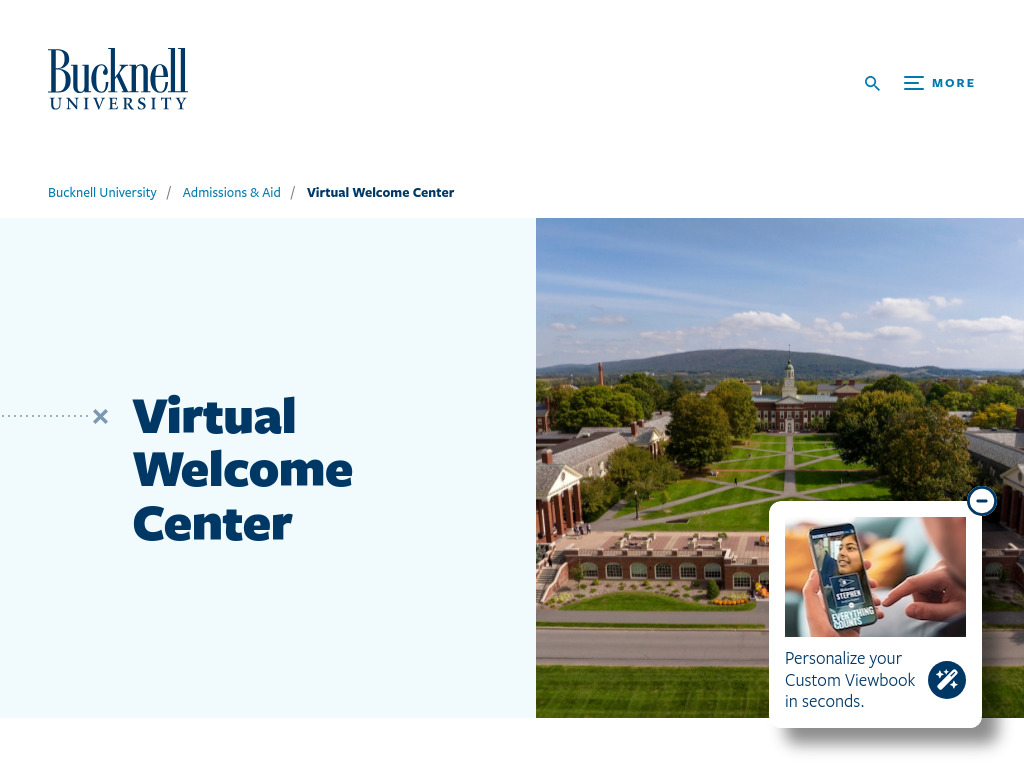
The tour lets prospective students explore the campus remotely, while the wider Welcome Center connects that experience to the information someone is likely to need during their college search.
It isn't an interactive video ad, technically, but it shows what could happen after someone interacts with one.
The ad doesn't have to contain the whole experience, it could just be used to get the right student into a much richer one.
And Valparaiso University has turned recruitment into a game
Here's where "Play" gets particularly literal.
In August 2026, Valparaiso University launched Valpo FutureQuest, a browser-based, open-world video game aimed primarily at prospective undergraduate students.
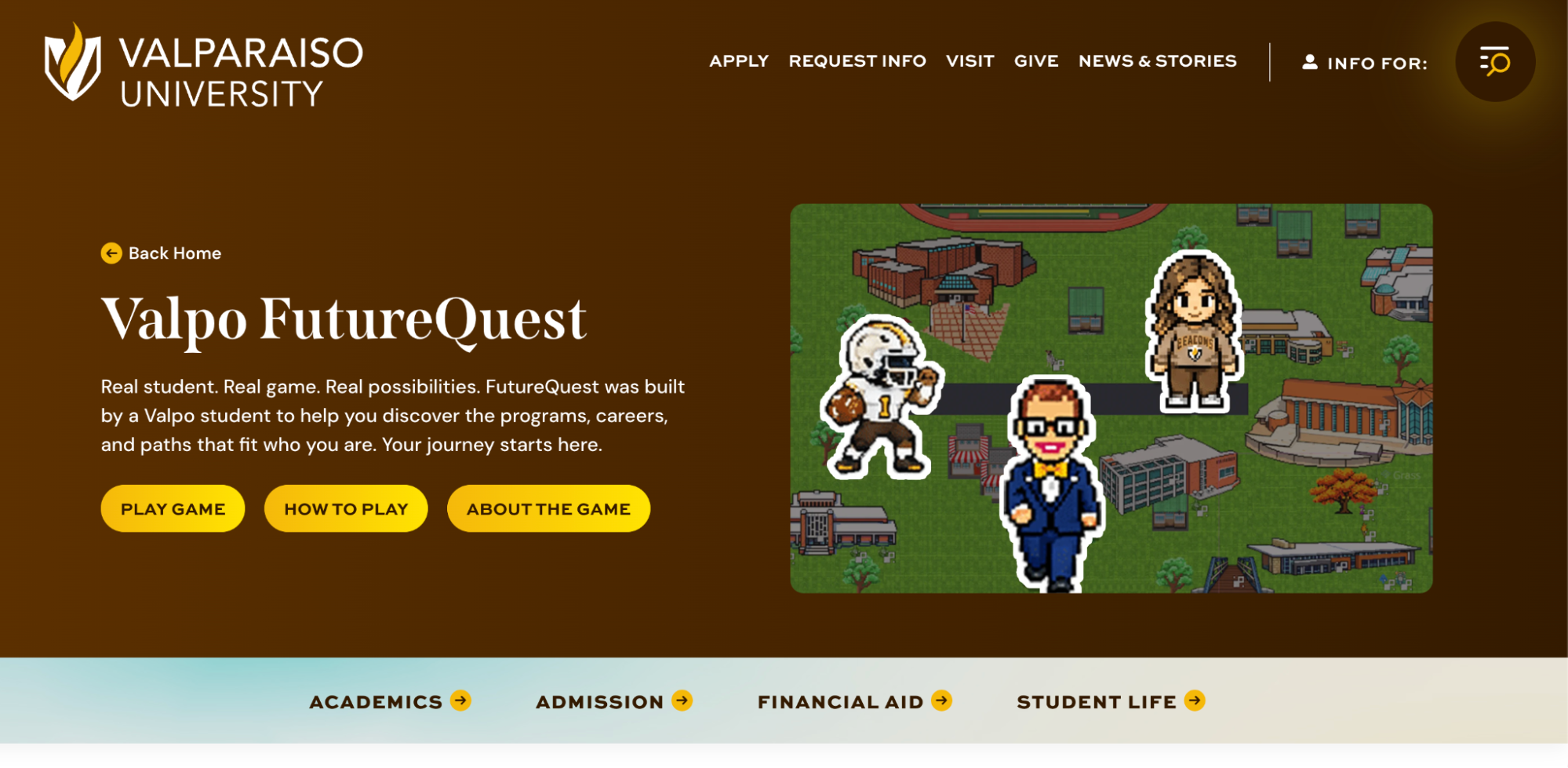
https://www.valpo.edu/valpo-futurequest/
Players explore an 8-bit version of the campus, meet Valpo-inspired characters, collect items, complete side quests and answer questions based on the O*NET Interest Profiler.
Those answers eventually generate an archetype designed to help the player explore possible academic and career paths.
At the end, they're redirected to a relevant page on the University website based on where they are in the admissions process.
The game was also largely developed by students.
Computer Science graduate Mason Tulacz built it as his capstone project, with another student contributing much of its original soundtrack.
It's a particularly good higher education example of Play: asking someone to participate in the experience rather than simply consume your marketing.
We're not in "Apply Now" land anymore, Toto.
And social platforms are building more interaction into ads
For social teams, there's also something interesting happening in that sphere.
TikTok, for example, offers interactive add-ons for in-feed advertising.
Depending on the campaign and format, you can use features including display cards, voting and countdown stickers, pop-out elements, and gestures that ask students to tap or swipe.
Its Gesture format can reveal additional information after someone interacts with the ad, while Countdown Stickers can be used to send viewers to a landing page or add a reminder to their calendar.
For higher education, you don't have to work too hard to imagine the applications:
- An Open Day video could carry a countdown and registration route.
- A course campaign could invite someone to tap to reveal more information.
- A student recruitment campaign could ask a question before directing different audiences towards relevant content.
The technology's there, and there's a whole new world out there waiting for higher ed marketers.
You don't need to build a video game
(Thankfully.)
There are much simpler places to start.
You could develop short undergraduate recruitment video featuring students from several subject areas, but rather than finishing with the usual logo and "Find out more", give the viewer somewhere specific to go.
- Are they interested in engineering? Explore the labs and meet a current student.
- More interested in the arts? See the facilities and student work.
- Want to know what living there is actually like? Head to accommodation and student life.
- Or take a campus video you already have and connect it to course information, virtual-tour content, student stories and your next Open Day.
You probably already have the content, you just have to join it together now.
Make the interaction earn its place
There is one obvious gotcha here though… and that's adding interaction simply because… you can.
If someone has to tap five things to find your entry requirements, you haven't created an engaging experience, you've just created more work for them. They won't thank you for it.
Instead, every interaction should answer a question, reveal something useful or move a prospective student naturally towards their next step.
And accessibility needs to be part of the brief from the beginning.
Captions, keyboard navigation, clear controls, accessible alternatives, and consideration for motion and audio matter even more once you start introducing additional layers of interaction.
A clever experience isn't much use if some prospective students can't use it.
Measure more than views
Traditional video metrics tell you whether somebody watched, but interactive experiences can tell you more about what they wanted to know.
Which subjects did people explore? Did they choose accommodation or scholarships? Did they register for an Open Day? Did international prospects interact differently? Where did people stop?
Those interactions can provide useful signals about prospective-student intent.
And that can help inform you for the next campaign, the next piece of content and potentially even the way you structure journeys across your website.
From watching to exploring
Interactive video isn't brand new. Universities have been experimenting with virtual tours, VR and interactive content for years.
What's changing is how easily the interaction can become part of the advertising and recruitment journey itself.
Don't tuck your experimental VR showcases away on a microsite: connect the creative directly with your course discovery and application information.
You don't necessarily need more video. You might just need to give prospective students more to do with the video you've already got.
Is it time to give prospective students something more to do than press play? How are you giving your students more control over the way they explore your university? Tell us on LinkedIn.