
:format()//media/Clearing-2026-higher-education-marketing-examples-RQ.png)
A-Level Results Day is here. Across the UK, students are refreshing UCAS Hub, checking results and making some pretty big decisions about where they might spend the next few years.
UCAS figures released this morning show a record 262,820 UK 18-year-olds have already secured a higher education place, up 3% on last year. At the same time, 144,010 applicants are currently free to be placed through Clearing, 10% more than at this point in 2025.
That's a sizeable audience still researching, comparing and making decisions today.
For university marketing and digital teams, that means one of the busiest periods of the year.
But the campaigns that caught our attention in 2026 weren't necessarily the ones shouting loudest on Results Day.
Many started weeks earlier. Others found clever ways to make Clearing less intimidating, quicker to navigate or simply a little more human.
Let's take a look at how some of the marketing themes are panning out.
What Clearing 2026 tells us
Look across these campaigns, and you might notice a few shifts.
- Clearing is becoming more entertaining: Some universities are making content that looks and sounds like the platforms it's appearing on.
- Clearing is becoming more self-service: Other universities are shortening journeys that once required several pages, forms or phone calls.
- Social is getting closer to conversion: For some, comment-to-DM approach is a particularly clean example of how the distance between seeing the content and taking the next step gets very short indeed.
- And the proposition itself is becoming more competitive. In turbulent economic times, some universities are treating financial and practical support as a central part of the Clearing campaign, not a footnote.
But we think there’s something else, too.
Underneath all of this is something simpler: reassurance.
A student coming to your website on Results Day usually wants to know three things very quickly: Is there a course for me? Can I talk to someone? What happens next?
Your content, CMS and wider digital infrastructure have to make those answers easy to find on a phone, under pressure, when thousands of other prospective students may be doing exactly the same thing.
And that's why the best Clearing work isn't really built on Results Day.
It's built months before it.
Clearing gets a little less serious
Clearing can be stressful. So it's perhaps no surprise that some of the best social content this year has focused less on explaining the process and more on acknowledging how it actually feels.
1. Queen Mary University of London: when the meme is also the user journey
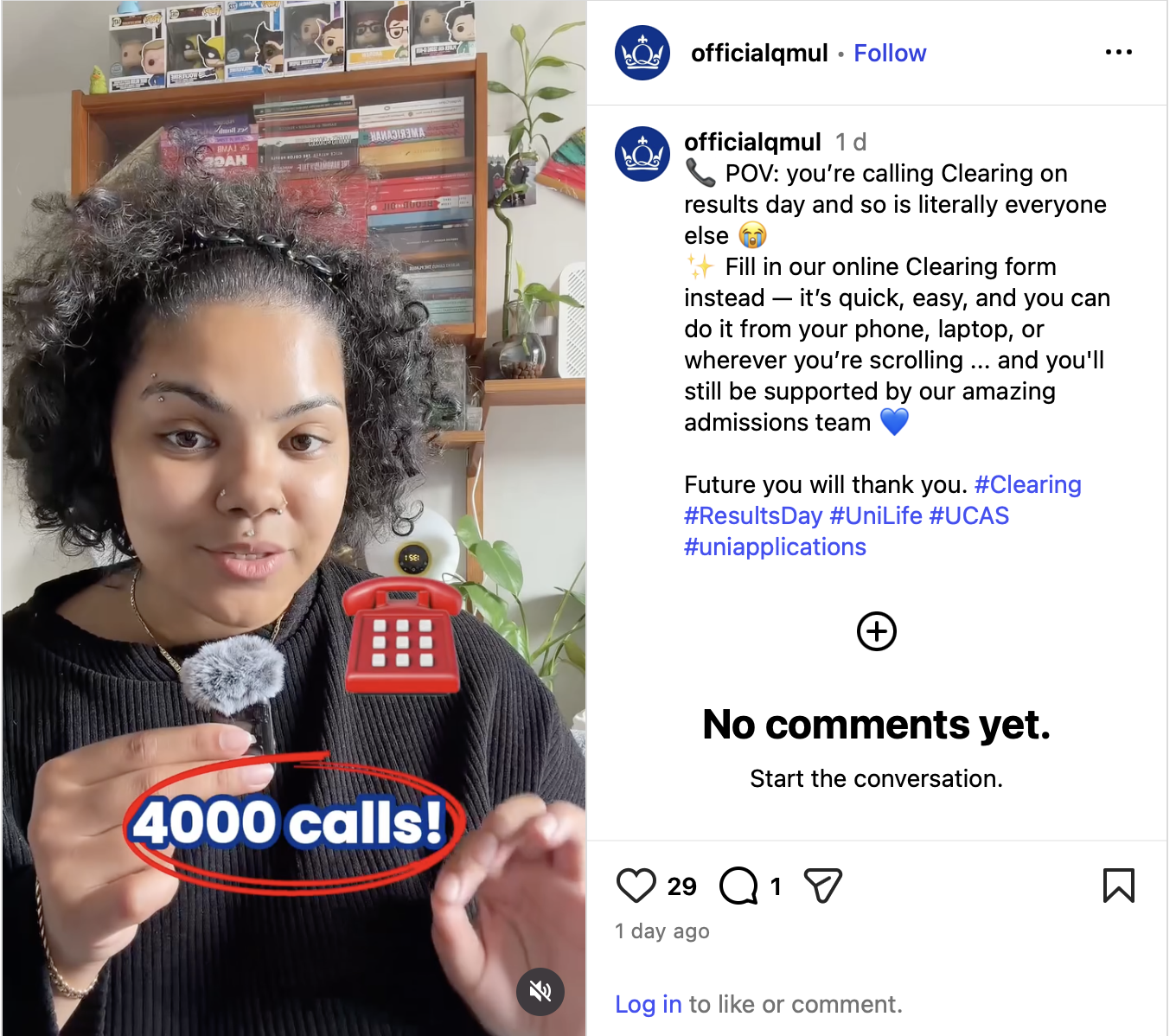
Queen Mary University of London's Instagram went straight for a familiar Results Day pain point: "POV: you're calling Clearing on results day and so is literally everyone else…"
The useful bit comes immediately afterwards: applicants are directed to the University's online Clearing form instead.
It's a simple joke, but it's also good journey design: identify the friction and offer an easier route.
2. University of Surrey: deliberately getting the trend wrong
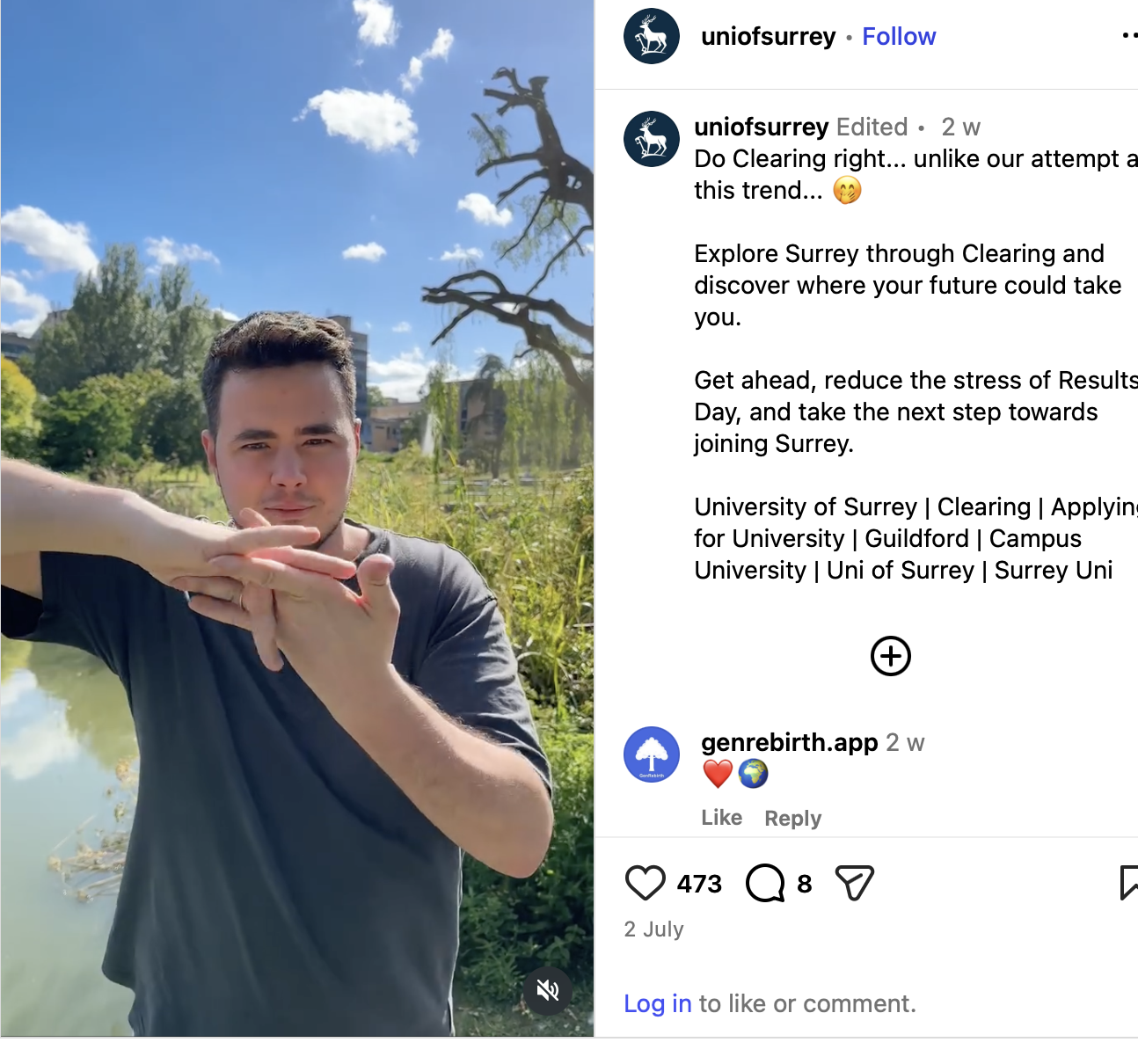 University of Surrey took a more self-deprecating route with "Do Clearing right… unlike our attempt at this trend…", using the slightly chaotic tone that feels far more at home on Instagram or TikTok than a polished recruitment ad.
There's a useful next step behind it too.
Clearing applicants can join Surrey's Unibuddy Community, including group chats covering courses, accommodation, clubs and societies.
Social engagement starts turning into belonging before students even arrive.
3. Northumbria University: treating Clearing like a content series
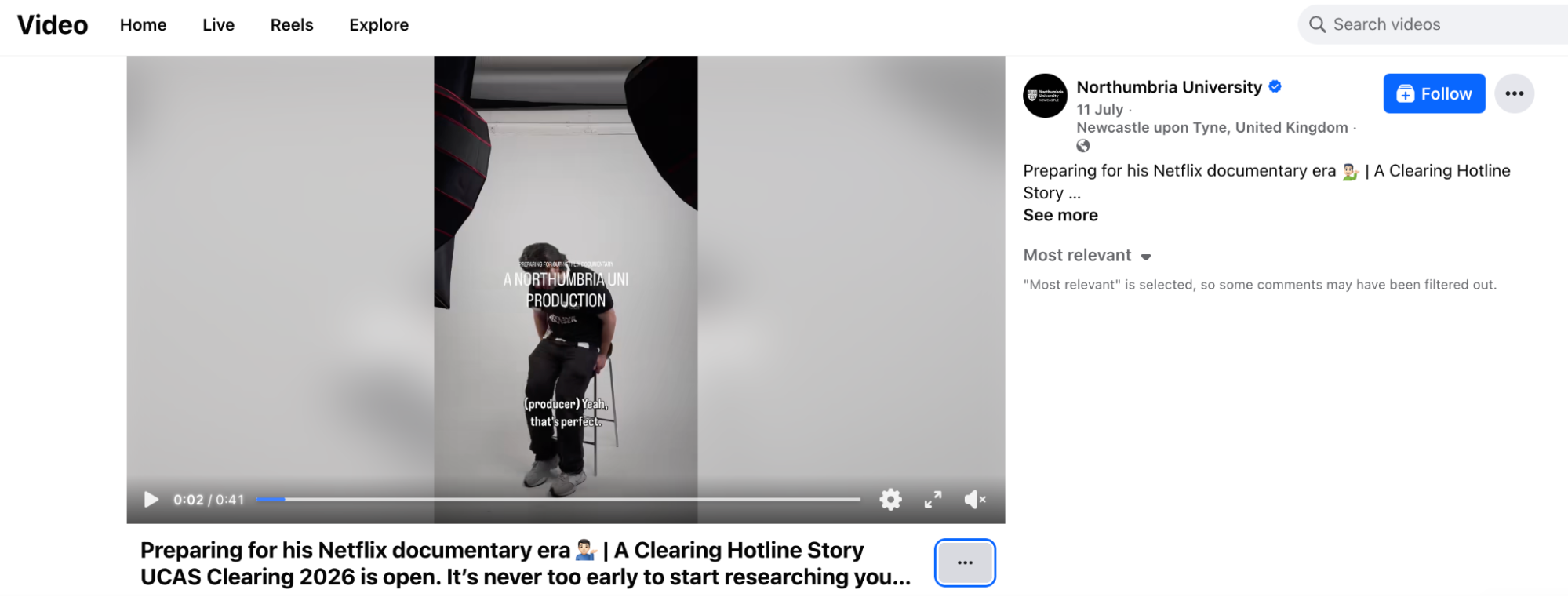
Northumbria University has leaned particularly hard into social-first humour.
One of its recurring Clearing pieces, "A Clearing Hotline Story," features the caption "Preparing for his Netflix documentary era".
It works because the content doesn't feel like an admissions notice wearing a TikTok hat... They have a recognisable tone and personality around the campaign, while the University's Clearing hub keeps the practical information and application journey close by.
4. University of Portsmouth: hard launching your uni era
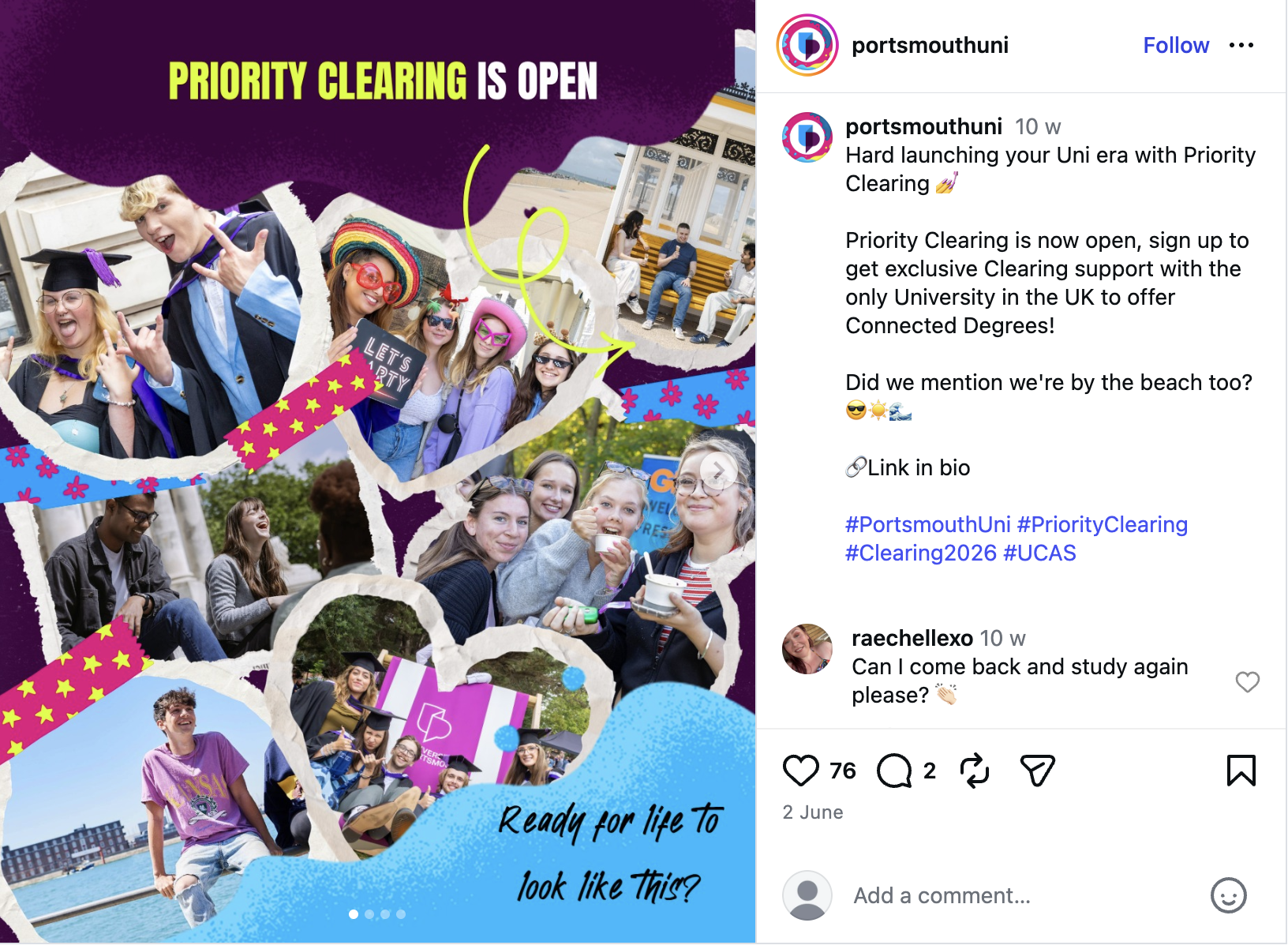
University of Portsmouth's "Hard launching your Uni era with Priority Clearing 💅" is another good example of using platform-native language without making the campaign meaningless.
Priority Clearing gives registered students something tangible: a priority phone line, Clearing events and webinars, accommodation information, exclusive updates and one-to-one application support.
The fun copy gets the click; the service gives students a reason to register.
5. University College Birmingham: showing what really happens when you call
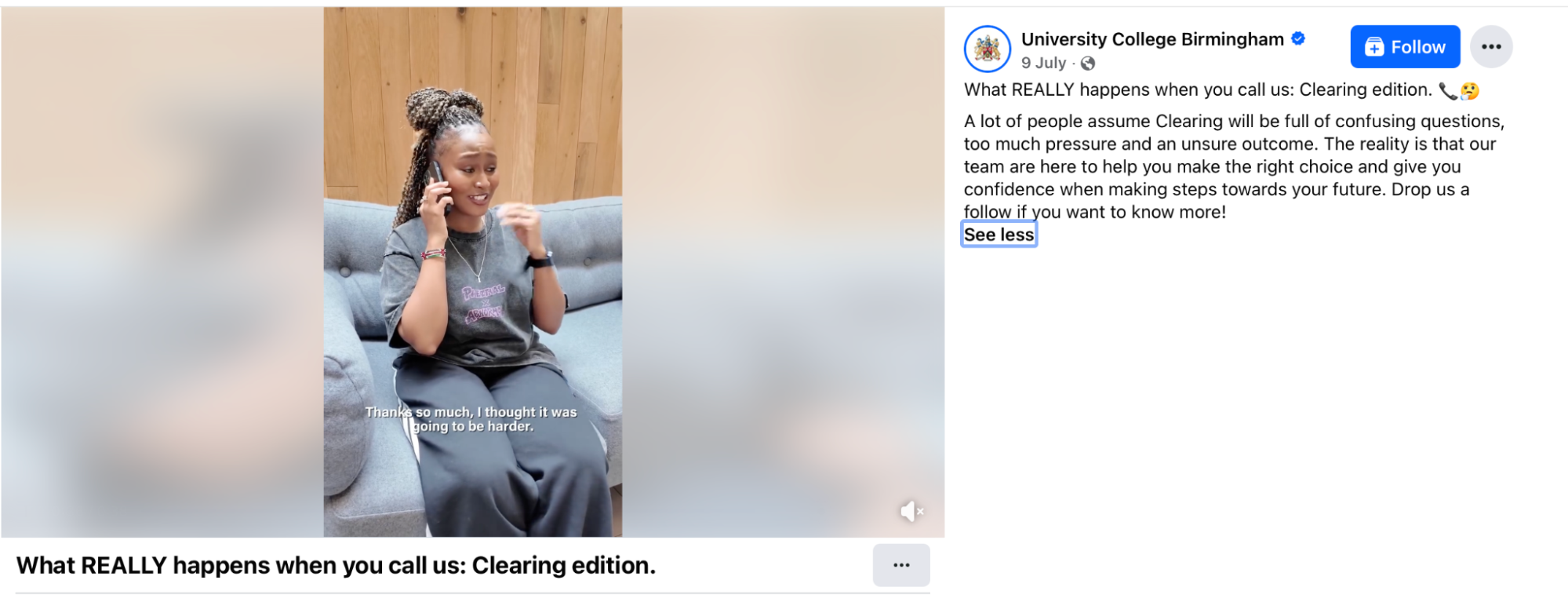
University College Birmingham tackled one of the more intimidating parts of Clearing head-on with "What REALLY happens when you call us: Clearing edition."
Rather than simply telling students not to worry, the short-form video shows them what to expect. UCB has also introduced members of its 2026 Clearing team on social media.
Sometimes demystification IS the campaign.
6. University of Winchester: meme first, reassurance second
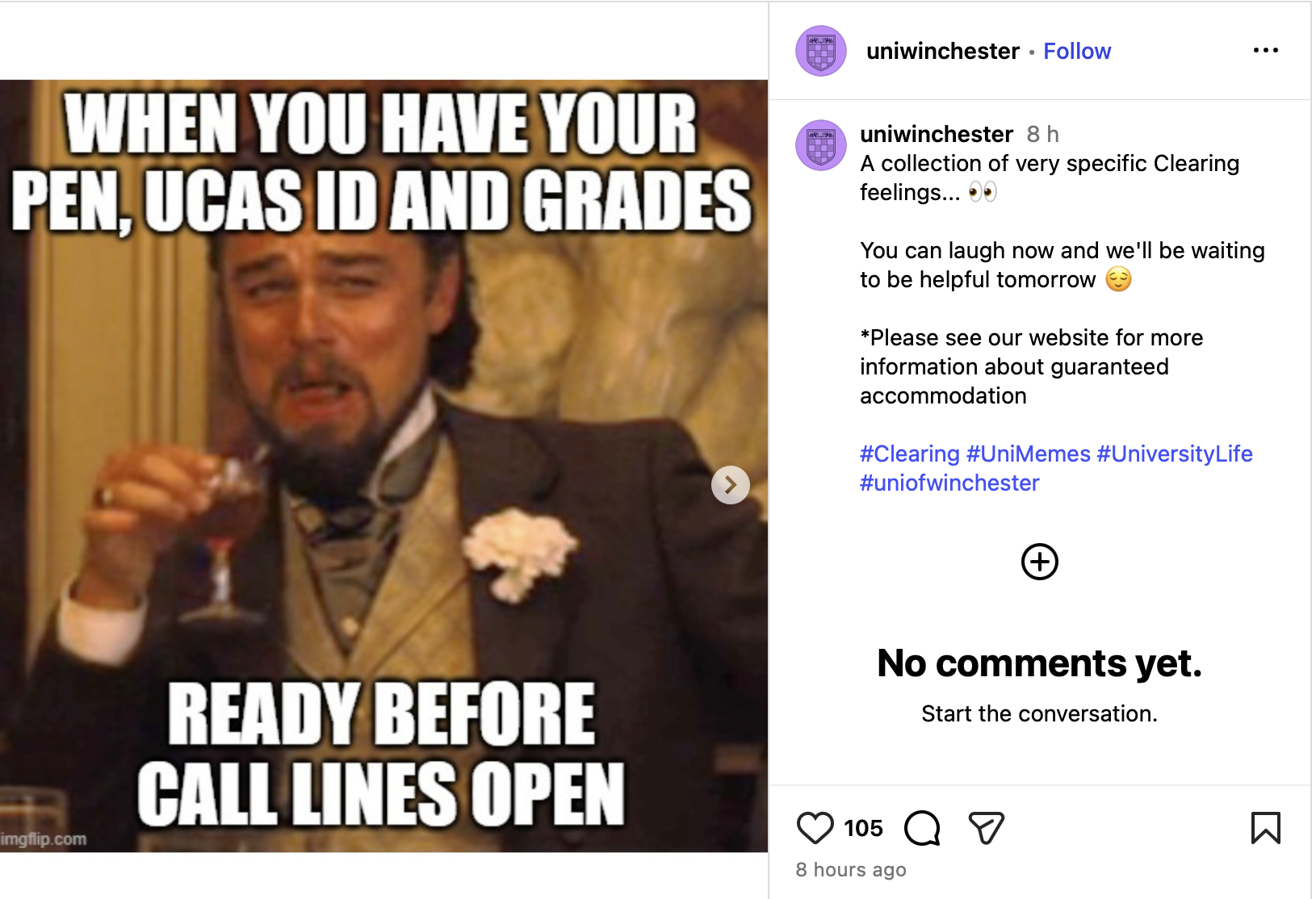
On the eve of Results Day, University of Winchester posted "A collection of very specific Clearing feelings…", using memes to capture some of the emotional whiplash students might be experiencing.
Behind the lighter content is a fairly substantial digital support journey: a Clearing calculator, WhatsApp and live chat, plus Campus Connect, where applicants can meet future classmates and join course and interest groups.
The common thread? None of these campaigns pretends Results Day is a calm administrative exercise.
They recognise the nerves, confusion and occasional absurdity of it—and sound more human as a result.
Making the next step ridiculously easy
Good creative gets attention. But during Clearing, what happens after the click may matter even more.
7. University of Bath: comment "Clearing"
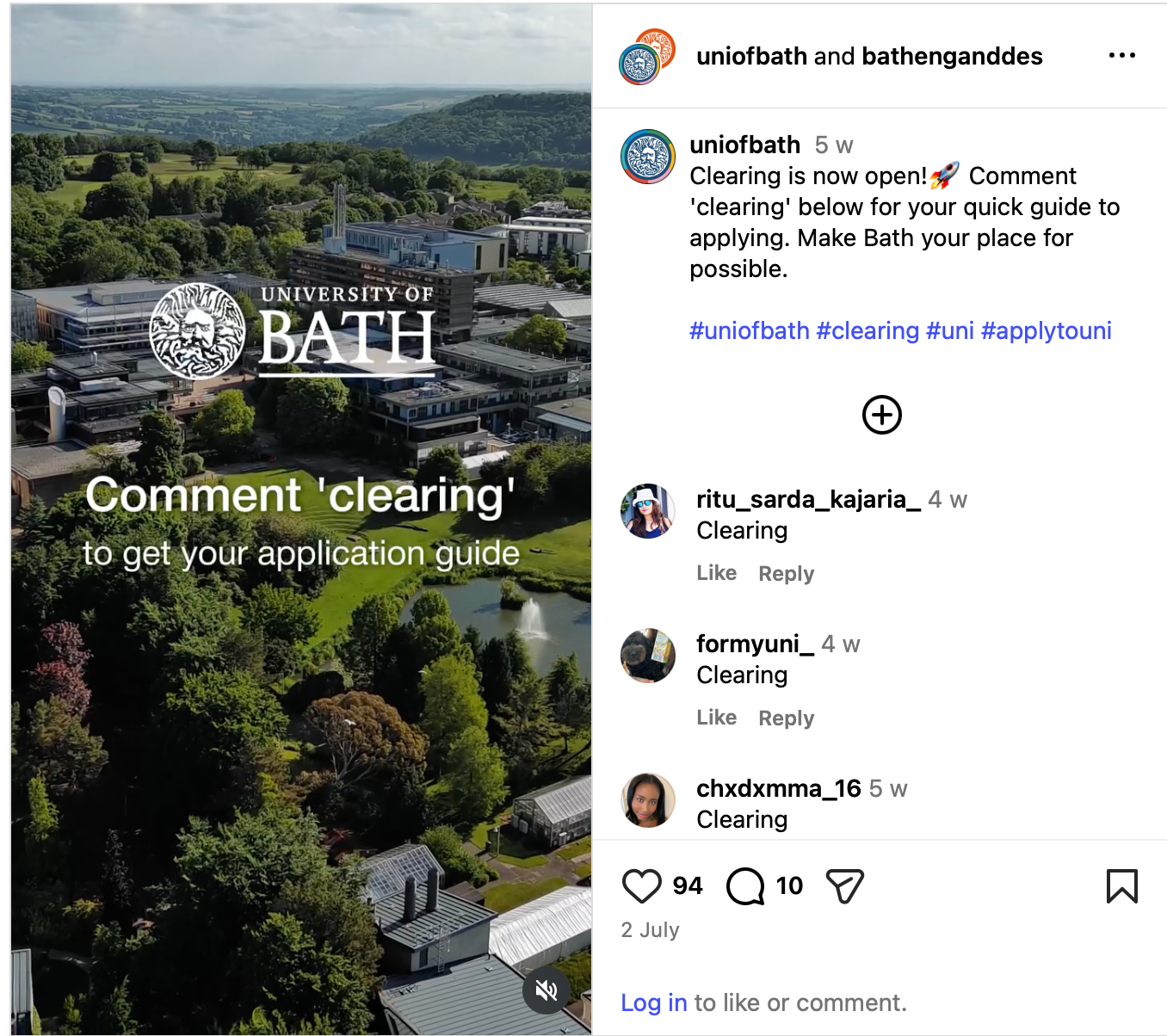
University of Bath has been using an especially neat social-to-web tactic. Prospective students are asked to comment "clearing" on Instagram to have relevant Clearing information sent directly to their DMs.
Instead of asking students to move from Instagram to a link in bio, then navigate the website to find the right information, Bath shortens the journey considerably.
A simple comment triggers a direct message with the relevant Clearing information, bringing the next step to the student rather than making them hunt for it.
8. University for the Creative Arts: an answer in under 60 seconds
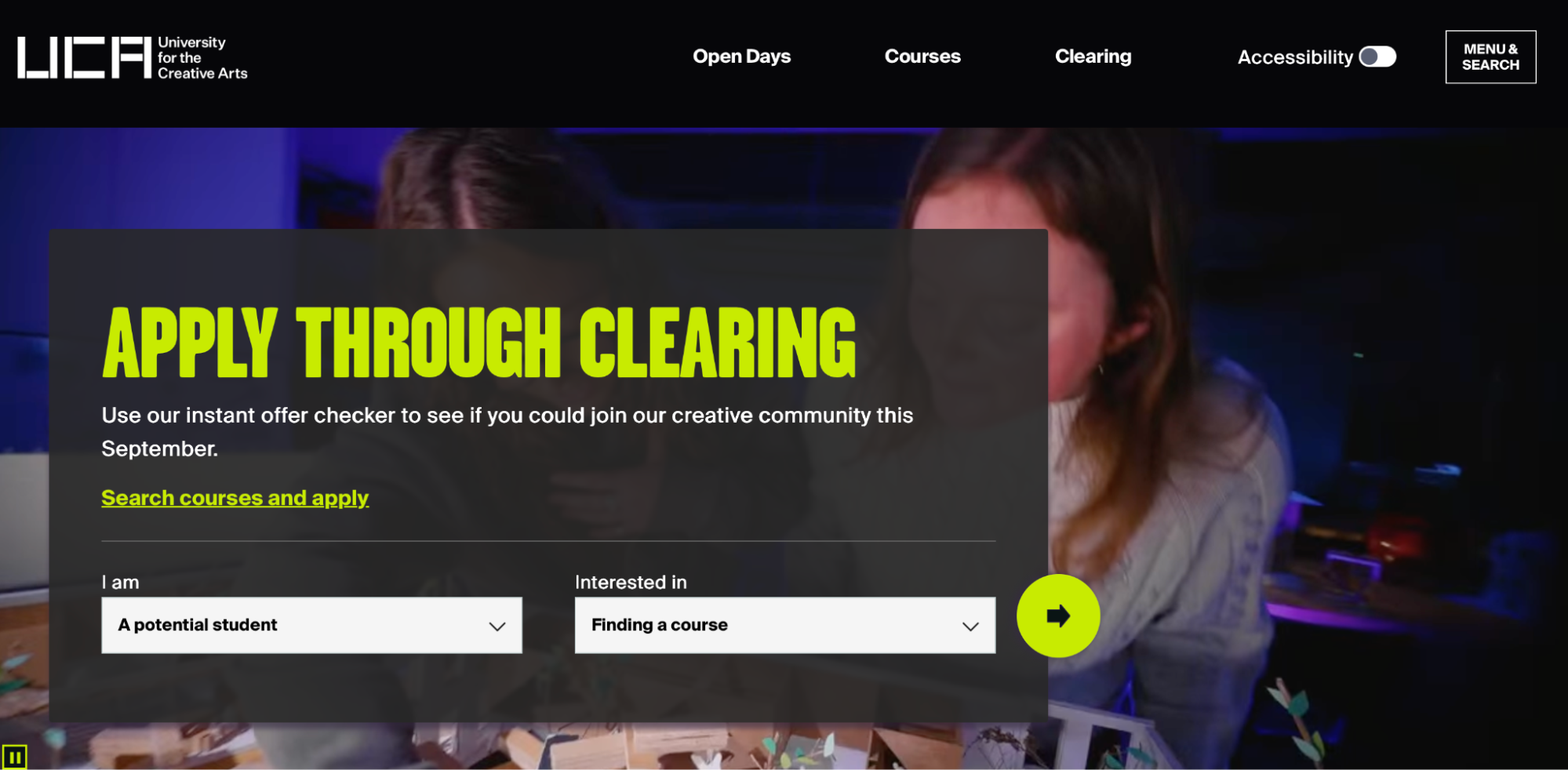
University for the Creative Arts has put an Instant Clearing Offer Checker prominently into its 2026 journey. Students enter their information and can find out in less than 60 seconds whether they meet the entry requirements for a course.
Even better, the checker is surfaced across individual Clearing subject pages, rather than being hidden away in admissions.
The innovation here isn't really an advert, it's what happens after the advert.
9. University of Greater Manchester: from details to potential offer

The University of Greater Manchester has taken the self-service approach a step further by building a three-stage Clearing journey directly into its website.
Students enter their details, course preferences and qualifications before moving towards a potential offer.
For eligible UK applicants, they can progress from initial interest without navigating multiple pages or waiting on a hotline, which is a much smoother alternative to the traditional "find a course and call us" model.
Getting there before Results Day
One of the clearest lessons from 2026 is that Clearing doesn't need to begin when the results arrive.
10. University of Gloucestershire: making applicants VIPs
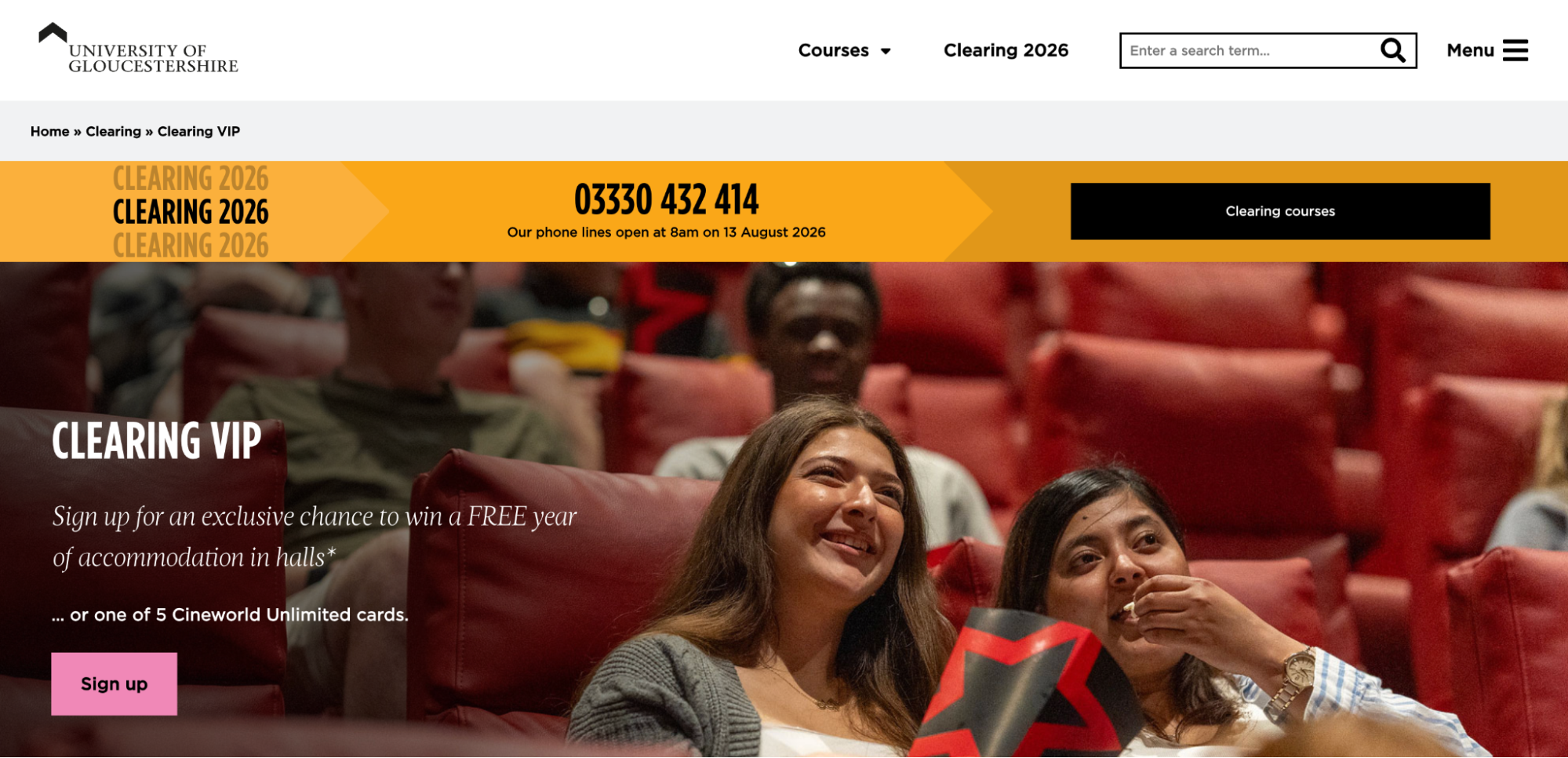
Univeristy of Gloucestershire's Clearing VIP programme gave prospective students a reason to engage well before Results Day, with early-bird offers, course updates, an 8am Results Day SMS and entry into a draw for a rent-free year in halls. By the time Clearing officially kicked into high gear this morning, those students already had an established relationship with the university.
Every useful interaction before Results Day reduces the amount a student needs to figure out when the pressure is actually on.
11. University of Leeds: "Strategic Clearing"
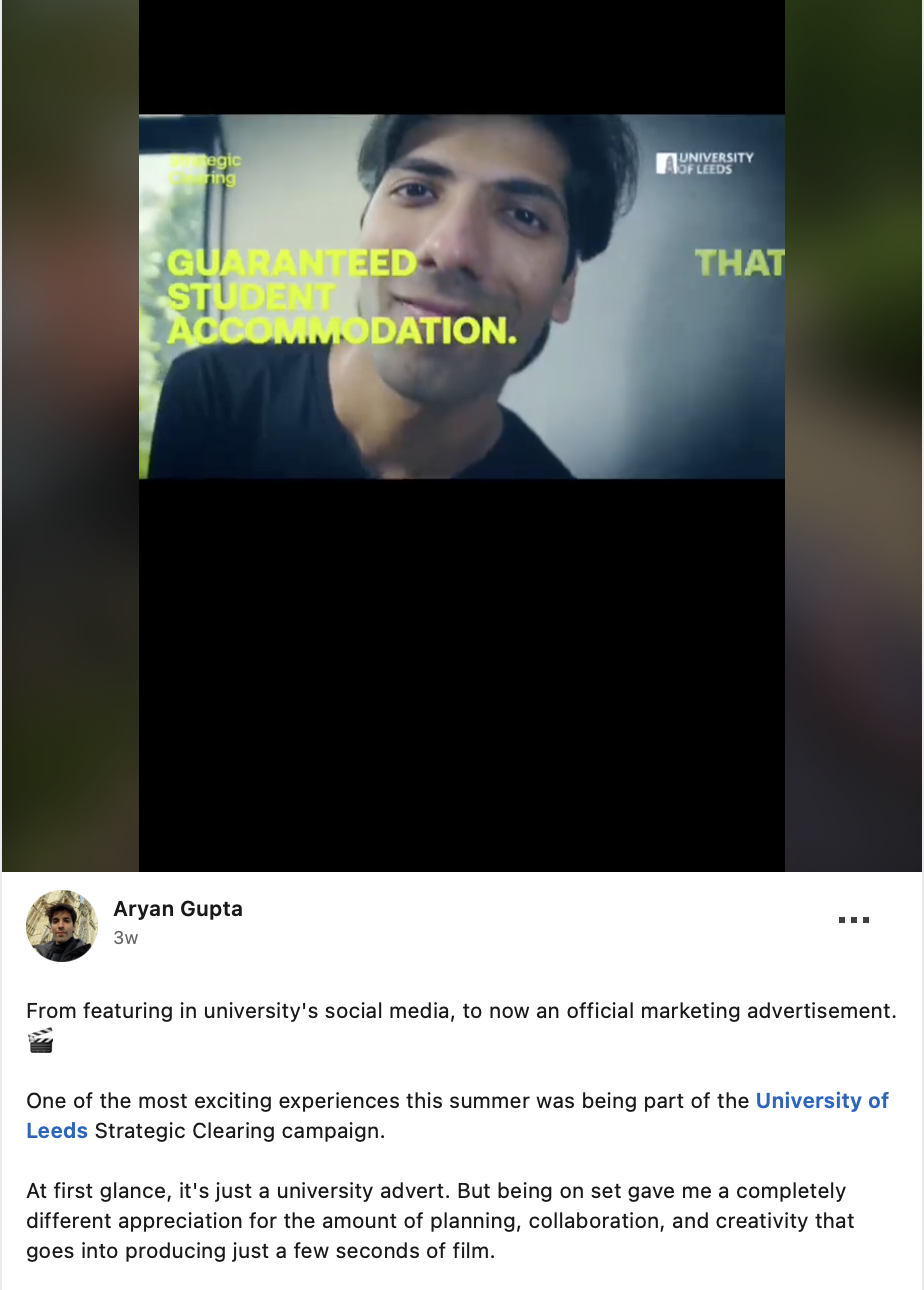
University of Leeds has formalised that pre-Results Day window as Strategic Clearing, allowing some applicants to secure a place ahead of the main Clearing rush and then confirm their results through a dedicated route on Results Day.
It's also being treated as a proper creative campaign.
A student featured in the 2026 Strategic Clearing advertising described working with a professional production crew through lighting, camera set-ups, direction and multiple takes.
The result is a campaign that feels considered, ambitious and deliberately designed to make Clearing stand out, rather than simply support it.
When the offer itself becomes the campaign
Universities are also becoming noticeably more creative—and competitive—about what sits behind the Clearing message.
12. University of Gloucestershire: the "Plot Twist"
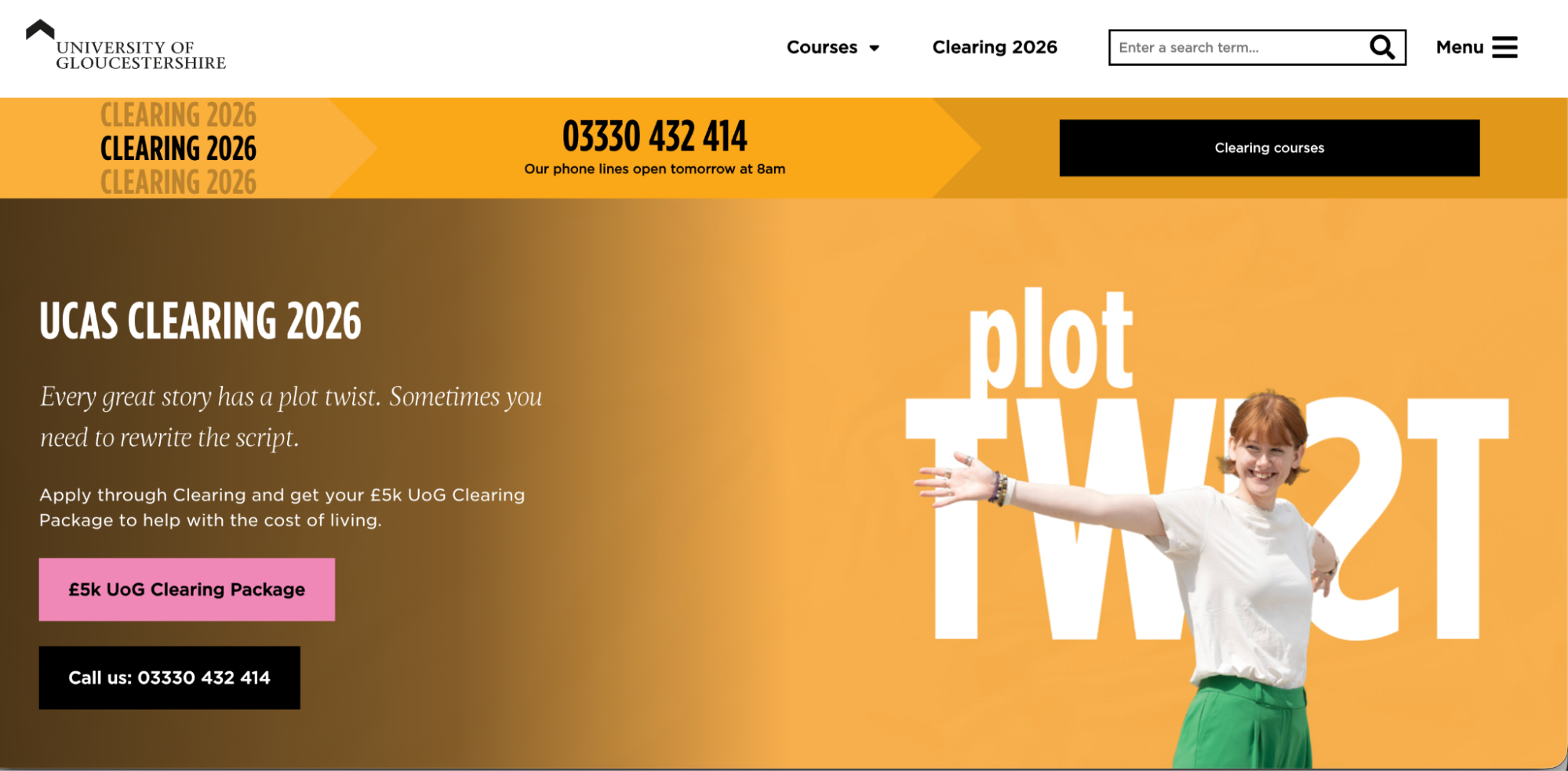
The Univeristy of Gloucestershire gets a second appearance because its wider 2026 campaign is doing something different from its VIP programme.
Its "Plot Twist" concept turns an unexpected Results Day outcome into a chance to "rewrite the script", and that idea carries through the main Clearing experience.
It then backs the campaign with a £5,000 Clearing package, principally through a £5,000 halls discount for qualifying students, with other options and perks available.
It's a good example of campaign creative and the actual proposition telling the same story.
13. University of Roehampton: Live. Work. Play.
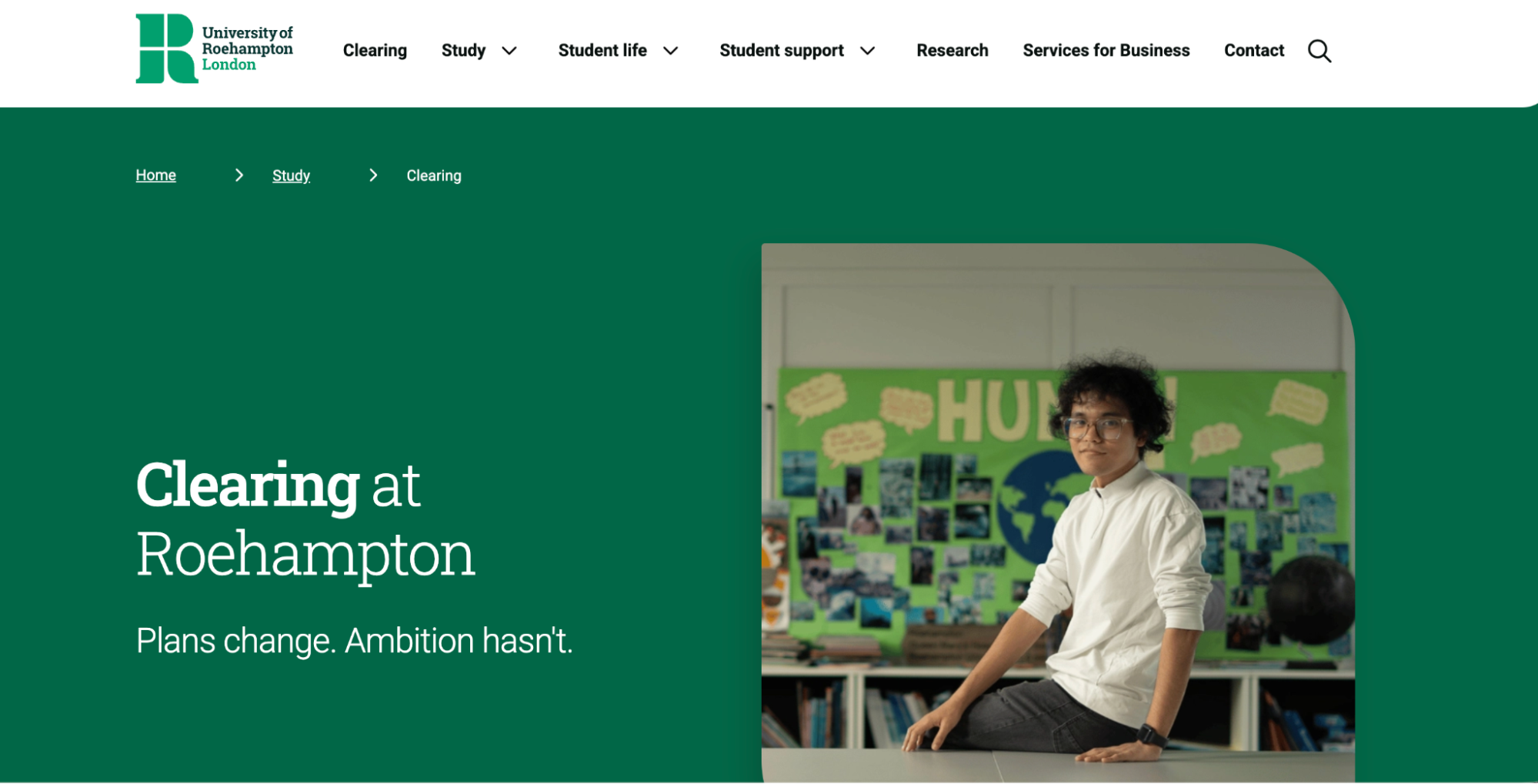
University of Roehampton has packaged its incentive around three different student priorities.
Qualifying Clearing students choose a £500 "Live, Work or Play" reward: £500 off first-year university accommodation, a £500 technology voucher, or a student-life package including services such as Netflix, Amazon Prime and Deliveroo Plus alongside FutureLearn Unlimited.
Giving applicants a choice makes the offer feel more personal and gives the campaign a bit more character than a standard discount ever could.
14. University of South Wales: up to £3,000 of practical support
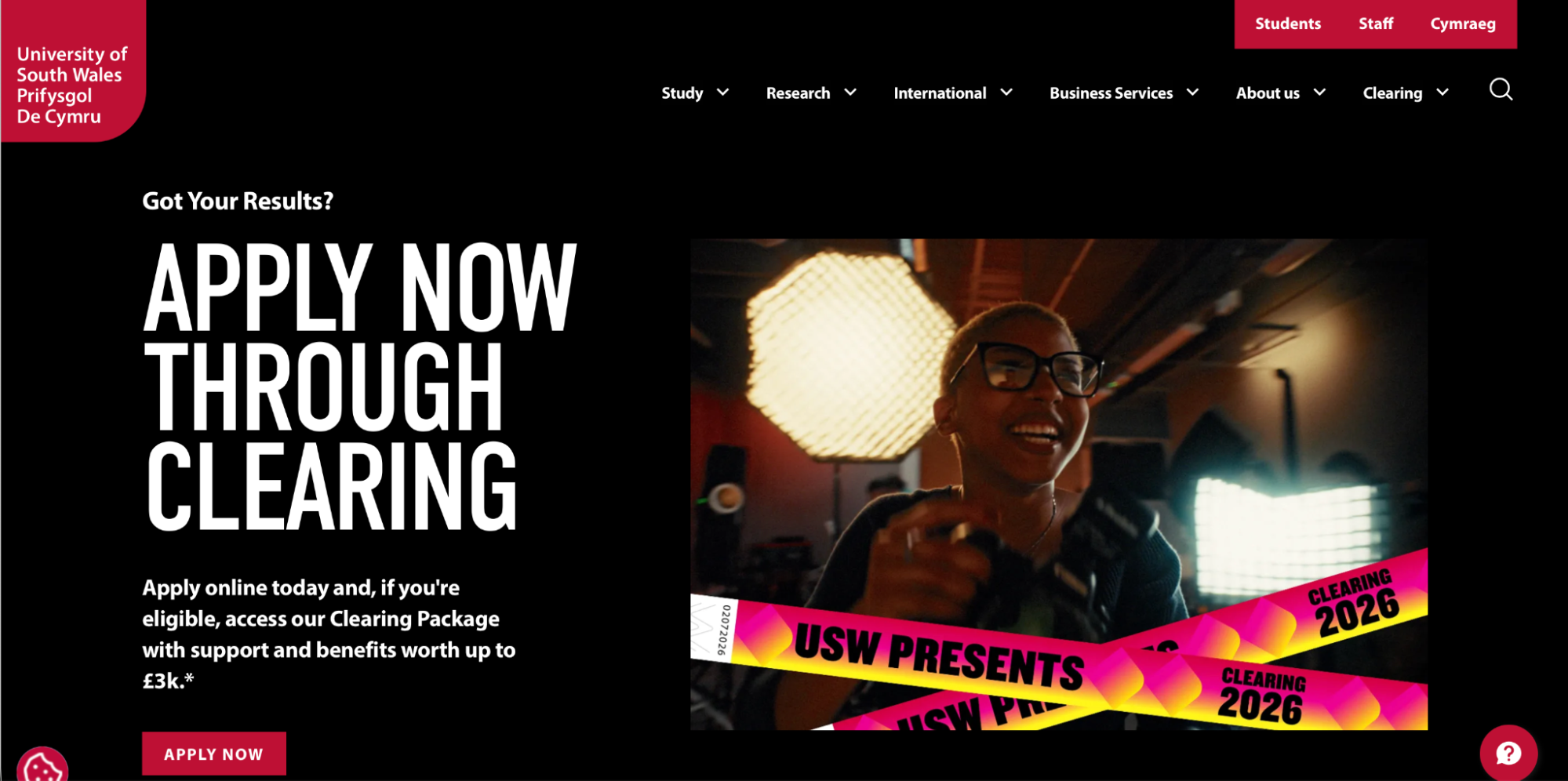
The University of South Wales/Prifysgol De Cymru has gone bigger, promoting a Clearing Package worth up to £3,000.
Depending on eligibility, that can include £1,500 off halls, a free laptop and £200 to use in campus cafés.
They’re not going for the quirky approach but rather putting a very practical response to cost-of-living concerns front-and-centre in the recruitment proposition.
15. UCFB: don't lose the brand when Clearing starts
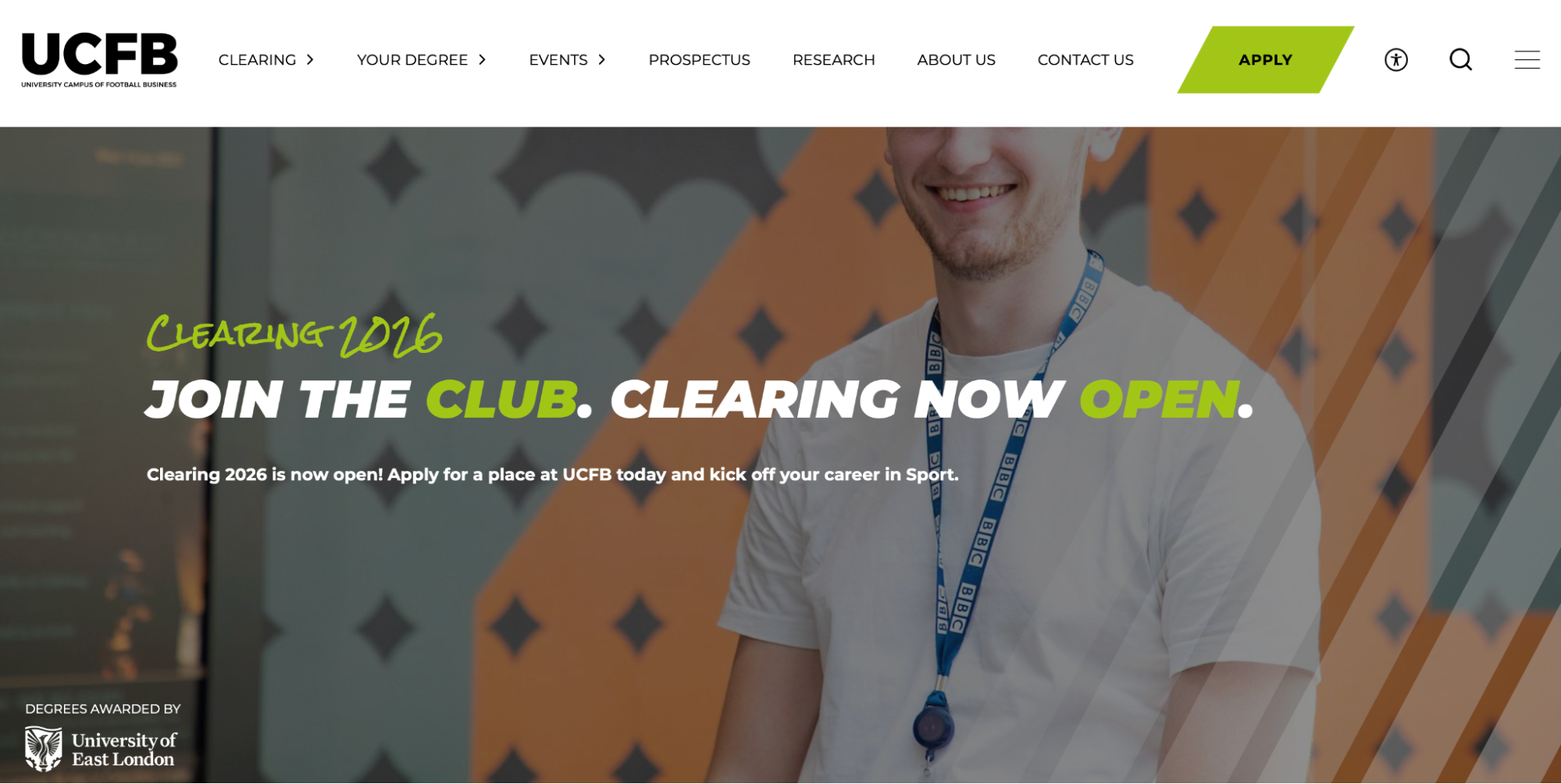
University Campus of Football Business (UCFB) takes a simple but effective approach by making sure its Clearing campaign still sounds unmistakably like UCFB. "JOIN THE CLUB. CLEARING NOW OPEN." leads the campaign, with football-focused messaging such as "kick off your career", "stay ahead of the game" and #KickOffYourCareer carried throughout the journey.
It’s a nice reminder that even when students need information quickly, Clearing content doesn’t have to become generic.
There’s still plenty of room for personality and a strong sense of brand.
One thing worth reviewing before next year
Pull up your Clearing page on a phone and put yourself in the position of a student who has just opened their results and is not where they wanted to be.
- Can they find a relevant course in two taps?
- Can they reach someone (via phone, chat, or WhatsApp) without navigating more than one page?
- Is there a pre-registration option that reduces the friction of that first contact?
If the answer to any of those is no, that's the work for spring 2027.
The universities that are going to perform best in Clearing 2026 didn't figure that out this morning...they figured it out in April.
What did you see work for you in Clearing 2026? We'd love to hear from higher-ed digital teams who were in the thick of it today. Find us on LinkedIn.