
:format()//media/Storytelling-Using-the-Hero’s-Journey-to-market-your-college-or-university-RQ.png)
Is this week’s blog article a long read? Yes… but we think you’ll like it! (Who doesn’t like great stories?!)
Storytelling in higher education marketing isn’t about hard selling your college or university. It isn’t about presenting a long list of facts and figures.
It goes deeper than that.
The best recruitment content tells a story that resonates—where the prospective student imagines themselves as the central character, setting out on a journey of growth, challenge, and transformation.
The best part? Students and alumni already have these success stories within them.
Your job is to help them frame and present their “Hero’s Journey.”
One standout example comes from Penn State World Campus, where a YouTube video tells the parallel journeys of Stacey Gustavson and her son, Alex Torres.
Stacey Gustavson recounts a deeply relatable journey for many mothers who delay their careers to focus on their family and young children.
What makes this YouTube video even more compelling is that it weaves the story of her son’s education at the same university into the narrative, showing how one family’s educational journey spans generations and life stages.
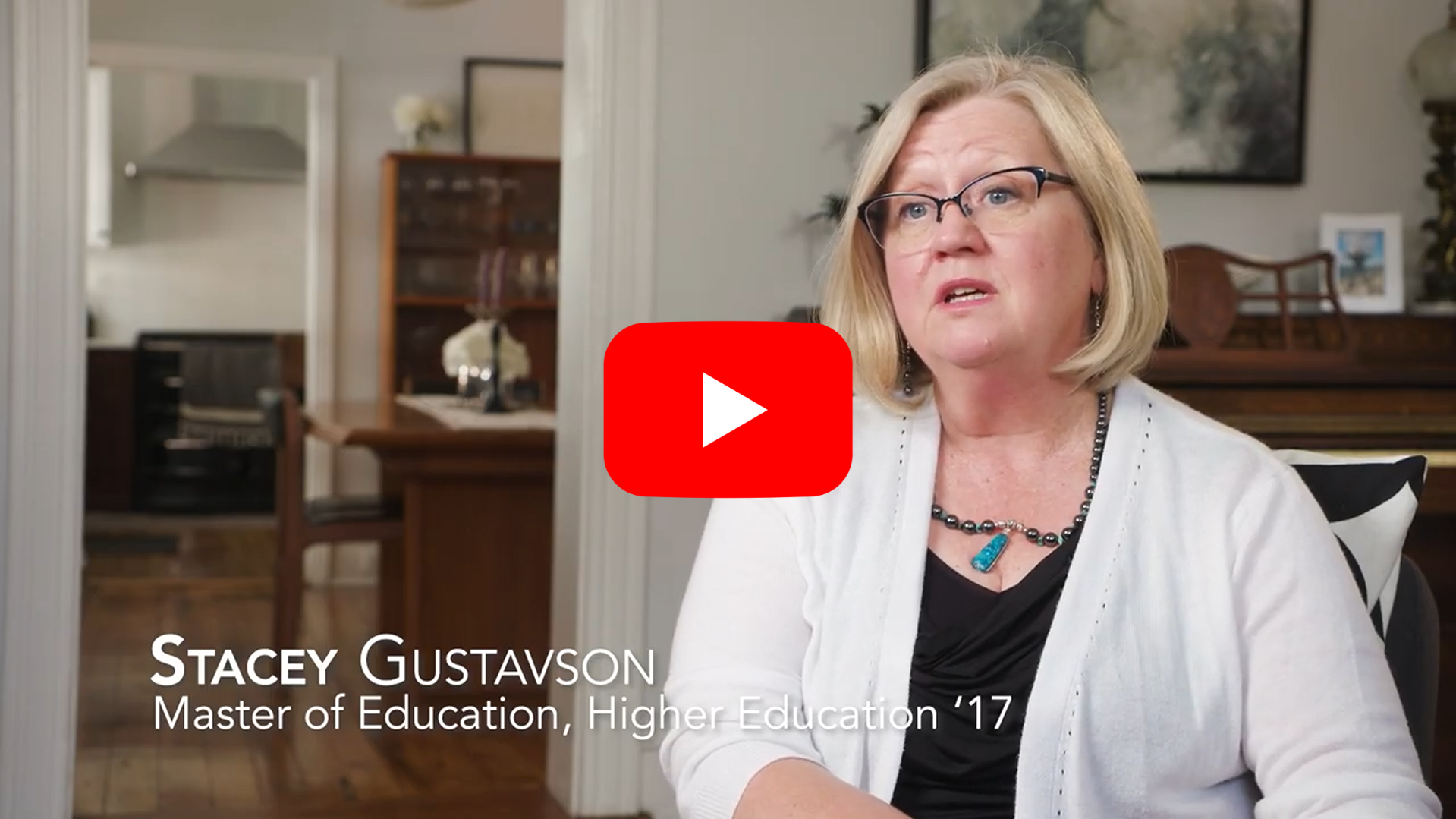
Penn State World Campus’s Student Success Story video tells a parallel tale of Stacey Gustavson and her son, Alex Torres, who are at very different stages in their respective educations.
What’s the Hero’s Journey?
The Hero's Journey is an engaging storytelling framework in which a protagonist (in our case, a current or former student) sets off on a transformative adventure, overcomes obstacles, and returns forever changed.
Think of it like a more emotionally charged and immersive method of showing a before-and-after result—with creative and inspiring events in between.
The Hero’s Journey is a powerful marketing tool that resonates with prospective students.
The Penn State World Campus video, for example, presents familiar and relatable experiences: overcoming adversity coupled with personal, academic, and professional growth and transformation (not simply listing a higher ed institution’s features and offerings).
The 5 elements of the Hero’s Journey
Like any story, the Hero's Journey can be as simple or complex as you’d like in order to elicit your desired marketing result.
These stories can contain one, several, or all of the elements of the Hero’s Journey—and sometimes the events don’t even have to occur chronologically.
However long or short, the key is to present a story that connects with prospective students on an emotional level and sparks a desire to be a part of a similar journey.
1) The Hero leaves their ordinary world & answers a call to adventure
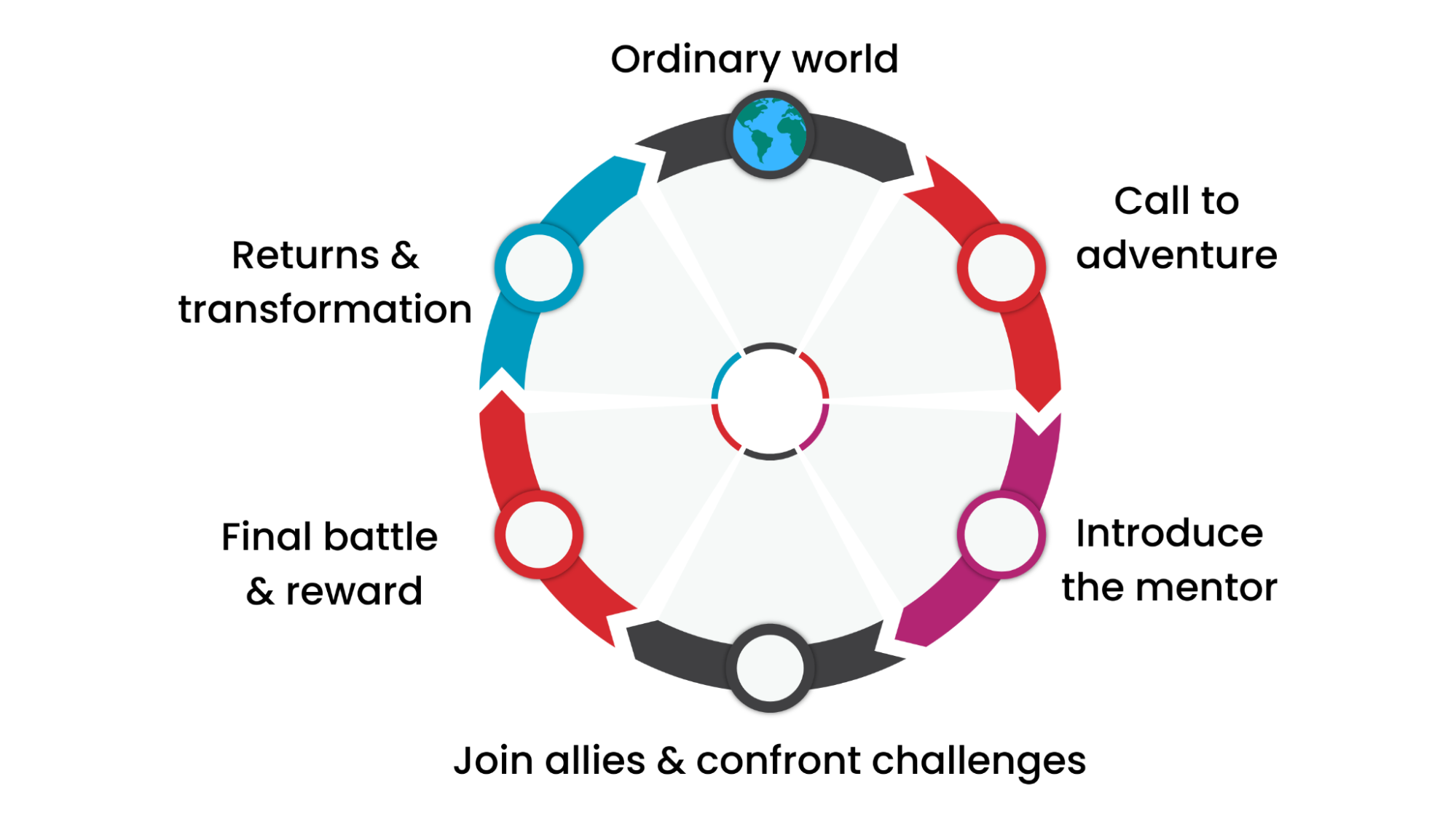
Every hero starts in the familiar before taking a leap to answer a “call to adventure” to seek higher education.
The “ordinary world” they leave behind isn’t necessarily a physical place. It can be a personal or professional situation—it can even be a mindset.
For some students, this might mean leaving home for the first time to attend an out-of-state university. For others, it’s returning to school after years in the workforce or raising a family, or an office worker seeking a promotion by returning to school to acquire new skills and credentials.
In Stacey Gustavson’s case, her “call to adventure” came from a desire to move from IT to student affairs, a career pivot that required new credentials.
2) The Mentor helps guide the way
This is where your institution comes in.
But resist the urge—consciously or subconsciously—to turn your school into the hero.
You’re the trusted guide, providing knowledge, direction, and resources to help the hero navigate their journey.
This is a perfect marketing opportunity to show how well the mentor is equipped to guide students through various obstacles, complete their journey, and succeed with whatever comes next.
For Stacey Gustavson, that mentor was Penn State World Campus.
Later in the video, we learn she became a mentor herself, encouraging her son Alex to enroll after his education was disrupted by COVID.
The guide becomes part of a legacy, a powerful message for multi-generational student recruitment.
3) Hero confronts challenges and finds allies
Every student will have to face obstacles—big or small—along their journey.
Academic pressure. Financial hurdles. English as a second language. Self-doubt. Family responsibilities.
It’s your opportunity, as their mentor, to show empathy in your marketing and storytelling; to acknowledge you understand what they’re going through and introduce them to their allies: student counselors, financial advisors, tutors, student wellness centers, flexible course schedules, and student-run clubs and communities.
These allies should always be included in the Hero’s Journey to show prospective students they’re not alone.
Stacey Gustavson had a great sense of where she wanted to take her career. But she had to overcome her particular obstacle: the lack of specific degrees for her desired role.
Although not mentioned, we can imagine that family responsibilities also played a part.
For Stacey, affordability and flexibility were key. She could apply her learning immediately to her job, balancing family life and career development thanks to the allies she found in the structure of her program.
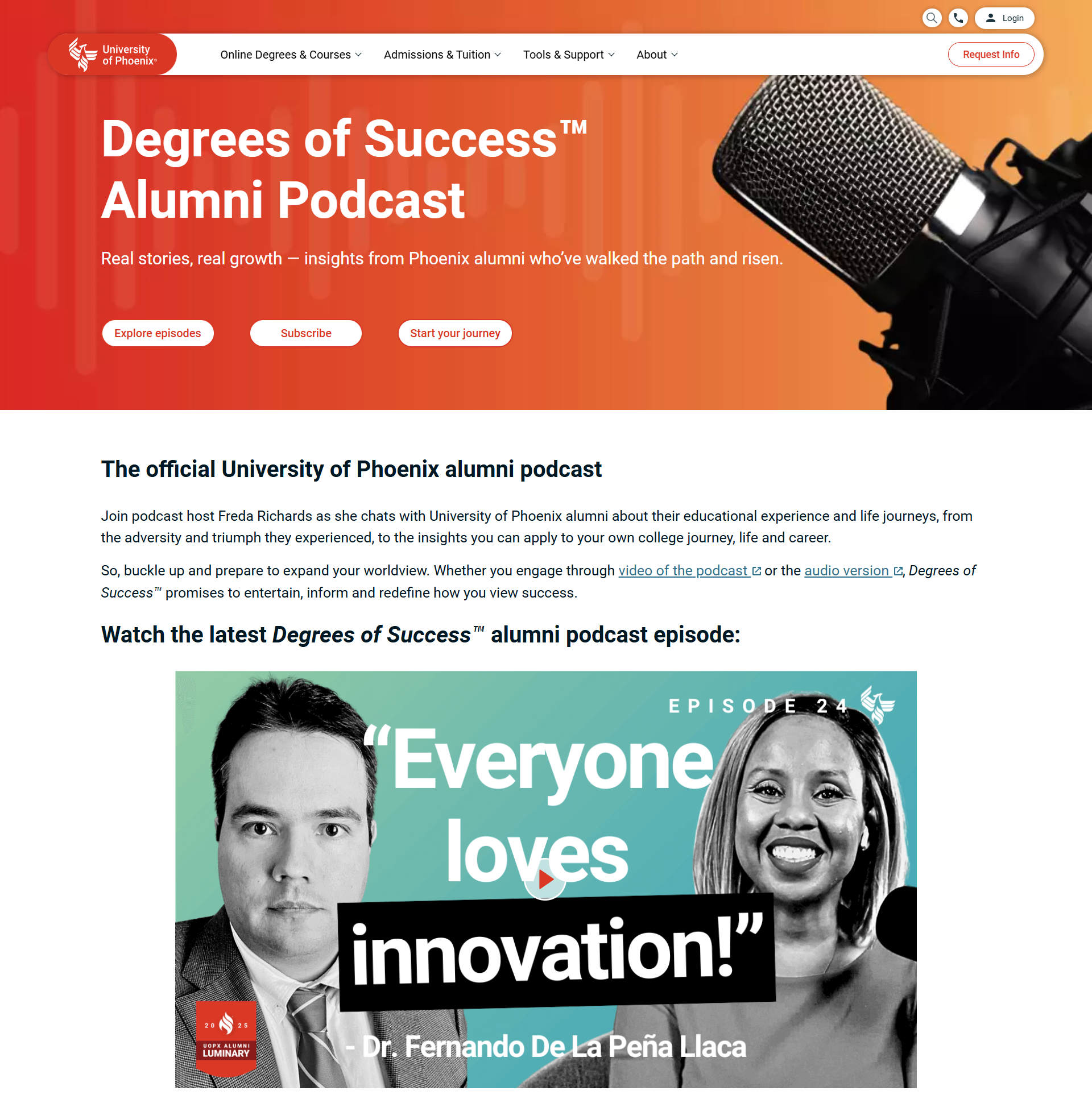
The University of Phoenix’s official alumni podcast, Degrees of Success Alumni, features interviews of former students who share inspiring journeys, including overcoming adversity, personal and professional successes, and how higher education played a mentor in their transformative journeys.
4) The Hero prepares for the final battle and receives rewards
The final battle is the story’s climax, where the hero overcomes the last hurdle on their way to a new and successful life.
The thesis. The capstone project. The internship that leads to a job.
The marketing messaging opportunities at this exciting stage of the journey are enormous.
It ties the journey together—showing how the hero, with help from mentors and allies, overcame obstacles and earned their reward: a degree and a new beginning.
While the Penn State World Campus video doesn’t explicitly show Stacey Gustavson’s “final battle”, we see the reward and outcome: a master's degree and a promising career.
As a higher ed marketer, you don’t need to cover every challenge.
Focus on the moment of triumph. Let viewers feel the reward—and imagine their own.
5) The Hero returns to their world transformed
The hero, having successfully overcome all obstacles, is now a graduate and triumphantly returns to an elevated “ordinary world,” a new person.
Your student has grown. They’ve achieved their goal—and now they’re stepping into a new career, a new identity, a new life.
They’re now equipped with the knowledge and skills to tackle their next adventure.
Alumni stories are one of the most valuable higher ed marketing tools.
They offer prospective students a glimpse at what’s possible. The message? You could be next!
For Stacey, her degree at Penn State World Campus unlocked a future that provides a promising career in a field she’s passionate about.
That’s the heart of the story.
Tips for crafting the Hero’s Journey
A well-told story helps readers or viewers connect with its characters, and more importantly, to imagine themselves in these characters’ shoes.
Here are some tips to market your heroes’ journeys:
- Start with a clear narrative direction: You should have a clearly defined story and emotional direction (e.g., inspiring, humorous, quirky) before you start writing or filming. Once established, guide participating students within this narrative.
- Make the student the hero: Yes, your college or university will feature prominently in the story, but resist the temptation to make your school the hero. Remember that this is the student’s adventure—it’s what will make the story relatable to prospective students.
- Avoid overwhelming the reader or viewer: You don’t need to include every stage of the Hero’s Journey—some parts, like the final battle, can be implied. If a student shares their pride in earning a PhD, the struggle behind it is already clear.
- Highlight the individual, not the collective: Whenever possible, showcase individual students sharing their experiences with readers or viewers. Personal stories are more effective, engaging, and intimate than collective “student body” experiences.
- Choose authentic over polished content: Genuine, sometimes even raw, emotion in storytelling will always resonate more than glitz and glamour—you don’t want your Hero’s Journey to look like a blatant commercial.
- Encourage your students to use their own words: Let your heroes tell their stories in their own words. While it’s perfectly fine to set the primary narrative and provide guidance, this generation values authenticity, so avoid scripting. Offer guidance, but let them express their journey, pride, and growth in their own voice.
- Appeal to the five senses: Use sensory details and language that brings the story to life. For example, instead of flat descriptions, ask students to recount the sight of walking through the lobby for the first time, the smell of coffee on their way to class, the buzz of study groups.
- Target multiple channels: A compelling story can be adapted for various purposes—from a long-form blog article to a YouTube video to a social media story. This allows you to reach prospective students in the platforms they use most.
- End with a call to adventure: Invite prospective students to begin their own journey by clicking on a link to read more about a program, schedule an in-person or virtual campus tour, or book an appointment with a student counselor or financial aid advisor. But, be gentle. You don’t want to end a nuanced and compelling Hero’s Journey with an overly aggressive marketing request.

Marshall University nails this with their call to adventure, “Live Your Marshall Moment.” Their Marshal Moment articles showcase success stories, including the inspiring journey of a former homeless addict who overcame his personal struggles to become a summa cum laude college graduate with a degree in social work.
Storytelling completes the decision-making process
Everyone loves a good story. It’s the reason people follow television series, year after year. It’s the reason people wait in line at the movies. It’s the reason people read a book until 2am.
Yes, facts and figures provide a wealth of information to help prospective students make informed decisions. But spreadsheets don’t inspire.
Students also make decisions based on emotion, identity, and possibility.
Mustering up the courage to leave the comforts of your hometown to seek higher education, overcoming personal fears to pursue a life-long passion, beating the odds by getting a scholarship to attend a university “I’ll never be able to afford”.
These inspire action.
In higher ed marketing, pure statistics are dry and pure emotion lacks credibility.
But when you combine data with authentic, emotionally rich student narratives, you create a full-spectrum marketing approach that engages both the brain and the heart.
Are you showcasing our student hero journeys? We’d love to hear what’s working at your college or university.