
:format()//media/Meeting-students-where-they-are-gaming-RQ.png)
Advertising your university in computer games: what's working
If you've ever watched someone play a football video game like EA SPORTS FC, you know the pitch-side ad boards feel just like the real thing.
So imagine the surprise when a student spots their university there.
That's what happened when Gerry Greyling of Bournemouth University (BU) shared a fun moment on LinkedIn: his son was playing FC26 and saw the BU brand pop up on the stadium's digital advertising boards—just like a real sponsor during a live match!
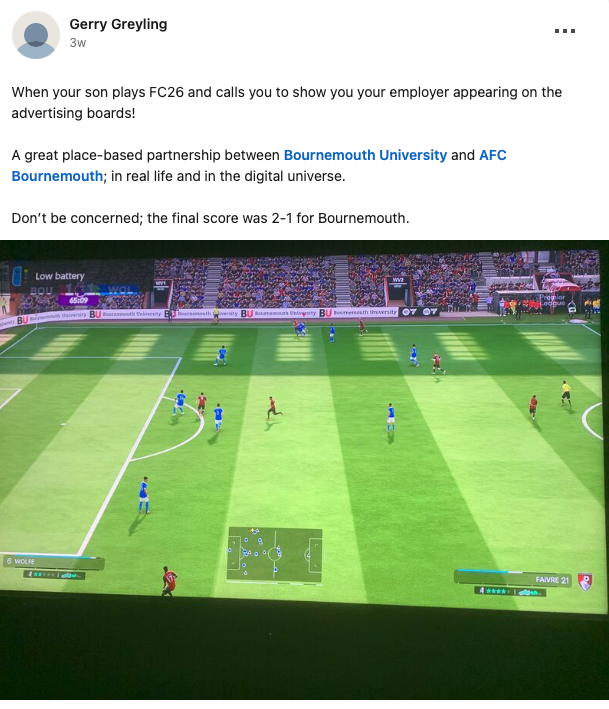
It wasn't a coincidence; it's part of a broader movement where higher education institutions are stepping into gaming spaces in ways that make sense to their audience.
Here's how it's playing out, why it works, and what your university can learn from it.
Bournemouth University and AFC Bournemouth
In FC26, the soccer (football) game includes virtual pitch-side advertising boards around the stadium—just like you'd see during a real broadcast match.
BU's branding appears on those digital hoardings, so when someone is playing (or watching someone play) the game, they'll see "Bournemouth University" on the perimeter boards as part of the match environment.
We loved this example, which was amplified on social media, as a natural extension of BU's partnership with AFC Bournemouth.
There's a real opportunity for universities and colleges to partner and advertise in gaming environments (and gaming content) to give their universities and colleges some serious attention.
And done well, it can work.
What's gaming advertising anyway?
In the higher education marketing field, we've seen "gaming advertising" shows up in three ways:
- Native in-game placements (like stadium boards in a sports game).
- Playable campus experiences (Fortnite islands, Minecraft campus builds, Roblox campuses).
- Gaming-adjacent media (sponsorships inside YouTube/Twitch gaming content).
BU is a cool example of #1: it's environmental branding that looks and behaves like real-world sponsorship.
Why this can work for higher education
In-game ads tend to be better received when they fit the environment and aren't intrusive.
Research on in-game advertising shows the importance of context and relevance and how these influence the attitude to the ad.
And in sports games, signage can help increase realism because it mirrors what students already expect from sports in real life.
It also creates a "recognition moment," where a student could think, "wait, is this a real university?". prompting them to a natural next step, to search.
Gaming environments also give you a different kind of presence away from social media (hello, Australia) that can have longer attention than a reel.
"Visit our campus" examples inside Fortnite, Minecraft, and Roblox
1. University of Staffordshire's StaffsVerse in Fortnite
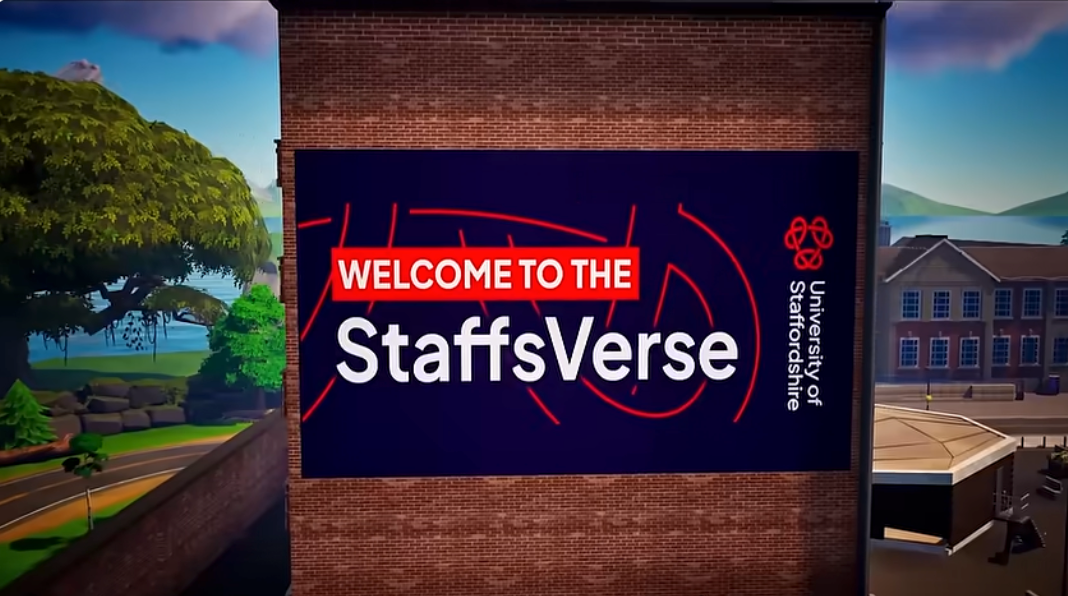
University of Staffordshire recreated its campus in Fortnite—positioned as an interactive way to explore facilities and community from anywhere, and used to support virtual open days and tours.
It was the UK's first university campus recreated as a Fortnite island, and was built by University of Staffordshire games students, allowing players to explore digital campuses and take part in interactive challenges from anywhere in the world.
It turns campus exploration into something students can choose to do, not something you ask them to sit through.
2. Queen's University Engineering recruitment event in Minecraft

Queen's University's Engineering department hosted prospective students on a Minecraft build of campus, pairing the tour with Q&A on Discord and an egg hunt to make it social and memorable.
It combined experience and conversation, a recruitment event with interaction and novelty built-in.
3. Peterborough College's virtual campus on Roblox

Over at Peterborough College, a student built a functioning virtual version of the campus on Roblox, including interactive facilities, positioned as a way for prospective students to get a feel for campus life before visiting.
It's student-made (authentic), smart, and practical (showing real facilities), which matters more than flashy graphics.
And if you want one more "proof point" that this isn't fringe: we've even covered the wider trend of students recreating campuses in Minecraft before.
Advertising around games (where attention already is)
Another effective way to capture attention is through sponsored segments within YouTube videos created by popular gaming influencers.
These creators already have the trust and attention of prospective students, who regularly watch their content to learn, improve their skills, and stay connected to gaming culture.
By integrating your message naturally into this environment, you university could reach audiences where prospective students already spend time, in a format that feels natural for them, building awareness and credibility at the same time.
So… should your higher ed institution do this?
Maybe…Here's the sensible way to think about it.
Start with "right to be there"
BU's in-game boards work because they're tied to a real partnership and a place-based story. If your university doesn't have that credibility, slapping a logo into a game environment can feel random fast.
A good internal test: Would a local student understand why you're showing up there?
Keep the message simple
In-game signage isn't the right place for a pitch; use just your university or college name, maybe a short credibility cue, and let the follow-up happen elsewhere. This is awareness building.
Make the "search moment" count
Most students won't click, but they may search. So make sure what they land on next is strong: a relevant landing page, scannable program content, clear next steps (open day, tour, inquiry), and answers to the questions students actually ask.
Measure like an adult
Attribution on these types of channels can be messy; that's to be expected.
But look for directional signals, like inquiry spikes, increased event registrations, direct traffic changes, etc. If you need a cleaner line of sight, use a subtle, memorable campaign phrase; not a long URL.
The bottom line
Advertising in computer games is a modern version of a familiar play: show up in a space your audience already cares about, in a way that feels natural, and then make it easy to take the next step.
BU's FC26 boards are a great anchor example because they're simple and credible.
But the wider pattern is even more useful: campuses in Fortnite, recruitment in Minecraft, virtual facilities in Roblox, and sponsorships inside gaming creator content are all showing higher ed the same thing: that you don't need to ‘win the feed' to win attention, you have to show up in the right context, with the right story, and a journey that does the rest.
Are you considering in-game advertising? We'd love to hear your experience with it!